
1.2 The Fundamental Theorem of Arithmetic
In earlier classes, you learned that any natural number can be written as a product of its prime factors. In this section, we go deeper and discover that this prime factorisation is not just possible, it is unique.
Examples:
$2 = 2$
$4 = 2 \times 2$
$253 = 11 \times 23$
Now let us look at natural numbers from the opposite direction:
Can every natural number be formed by multiplying prime numbers?
Let’s try to understand this.
Suppose you take a collection of prime numbers, for example:
$2, 3, 7, 11, 23$
If we multiply some or all of these primes, repeating them as many times as we want, we can create many positive integers.
For example:
$7 \times 11 \times 23 = 1771$
$3 \times 7 \times 11 \times 23 = 5313$
$2 \times 3 \times 7 \times 11 \times 23 = 10626$
$2^2 \times 3 \times 7 \times 11 \times 23 = 21252$
$23 \times 3 \times 7^3 = 8232$
This list can go on infinitely.
Now imagine that our collection includes all prime numbers. Since there are infinitely many primes, multiplying them in all possible combinations will give us an infinite number of positive integers.
But here is the important question:
Can we produce all composite numbers using primes?
Or is there a composite number that cannot be written as the product of prime powers?
To answer this, let us reverse the process and factorise numbers using the factor tree method.
Example 1: Factorising 32760
Using a factor tree:
$32760 = 2 \times 2 \times 2 \times 3 \times 3 \times 5 \times 7 \times 13$
This can be written as:
$$32760 = 2^3 \times 3^2 \times 5 \times 7 \times 13$$
This is the factorisation as powers of prime numbers.
Example 2: Factorising 123456789
$$123456789 = 3^2 \times 3803 \times 3607$$ (You can check that 3803 and 3607 are prime numbers.)
Try factorising some more numbers yourself—you will notice a pattern:
Every composite number can be written as a product of powers of primes.
Theorem 1.1: Fundamental Theorem of Arithmetic
Every composite number can be expressed (factorised) as a product of prime numbers, and this factorisation is unique, except for the order in which the primes appear.
In simple words:
• Composite numbers are built only from prime numbers.
• You cannot get two different prime factorizations for the same number.
• Only the order of the prime factors may differ.
⭐ The Fundamental Theorem of Arithmetic (Easy Version)
The theorem says that every composite number can be factorised into prime numbers. But it also says:
🔹 Every composite number has one and only one prime factorisation,
except for the order of the factors.
Meaning, these are all the same factorisation:
$2 \times 3 \times 5 \times 7$
$3 \times 5 \times 7 \times 2$
$5 \times 2 \times 7 \times 3$
This is why we often write prime factors in ascending order.
📘 Unique Prime Factorisation
For a composite number $x$, we write:
$$x = p_1 \times p_2 \times \ldots \times p_n$$ where $p_1 \le p_2 \le \ldots \le p_n$ and all are primes.
When we combine same primes, we get powers of primes.
Example:
$32760 = 2 \times 2 \times 2 \times 3 \times 3 \times 5 \times 7 \times 13$
👉 $$32760 = 2^3 \times 3^2 \times 5 \times 7 \times 13$$
🎯 Applications of the Theorem
Let’s look at a few simple examples.
⭐ Example 1
Consider the numbers $4^n$, where $n$ is a natural number. Check whether there is any value of $n$ for which $4^n$ ends with digit 0.
Step-by-step reasoning (easy)
✔ A number ends with 0 only if it is divisible by 10, which means it must contain both 2 and 5 as prime factors.
So if $4^n$ ends in 0, it must contain the prime 5 in its factorisation.
Now check the prime factors of $4^n$
$4 = 2 \times 2 = 2^2$ So,
$$4^n = (2^2)^n = 2^{2n}$$
This means: • Only prime factor = 2 • There is no 5 in the factorisation
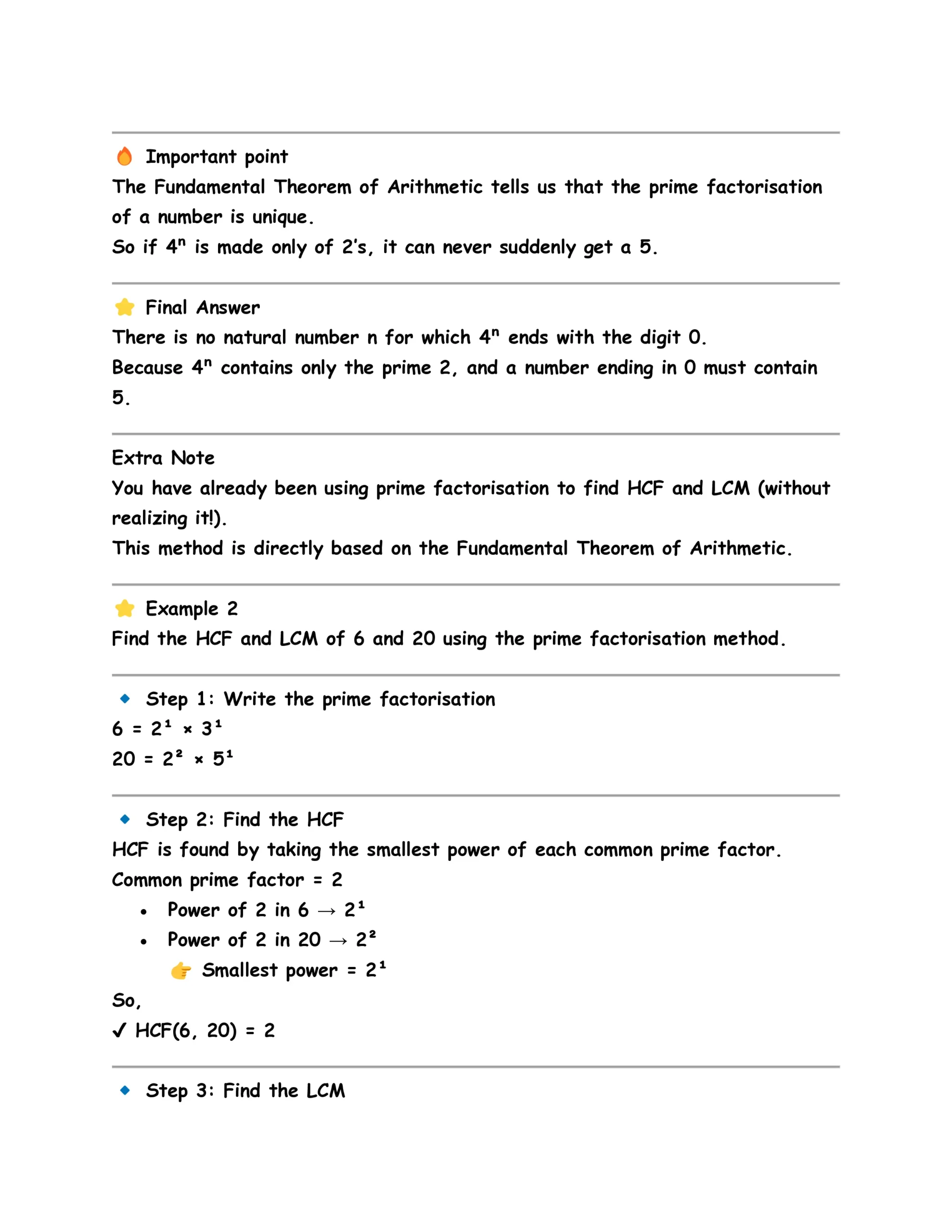
Important point
The Fundamental Theorem of Arithmetic tells us that the prime factorisation of a number is unique. So if $4^n$ is made only of 2’s, it can never suddenly get a 5.
Final Answer
There is no natural number $n$ for which $4^n$ ends with the digit 0, because $4^n$ contains only the prime 2, and a number ending in 0 must contain 5.
Extra Note
You have already been using prime factorisation to find HCF and LCM (without realizing it!).
This method is directly based on the Fundamental Theorem of Arithmetic.
⭐ Example 2
Find the HCF and LCM of 6 and 20 using the prime factorisation method.
Step 1: Write the prime factorisation
$6 = 2^1 \times 3^1$
$20 = 2^2 \times 5^1$
Step 2: Find the HCF
HCF is found by taking the smallest power of each common prime factor. Common prime factor = 2:
Power of 2 in 6 → $2^1$ Power of 2 in 20 → $2^2$ 👉 Smallest power = $2^1$
$$\text{HCF}(6, 20) = 2$$
Step 3: Find the LCM
LCM is found by taking the greatest power of each prime factor in the numbers. Prime factors involved: 2, 3, 5
Greatest power of 2 = $2^2$
Greatest power of 3 = $3^1$
Greatest power of 5 = $5^1$
$$\text{LCM}(6, 20) = 2^2 \times 3^1 \times 5^1 = 60$$
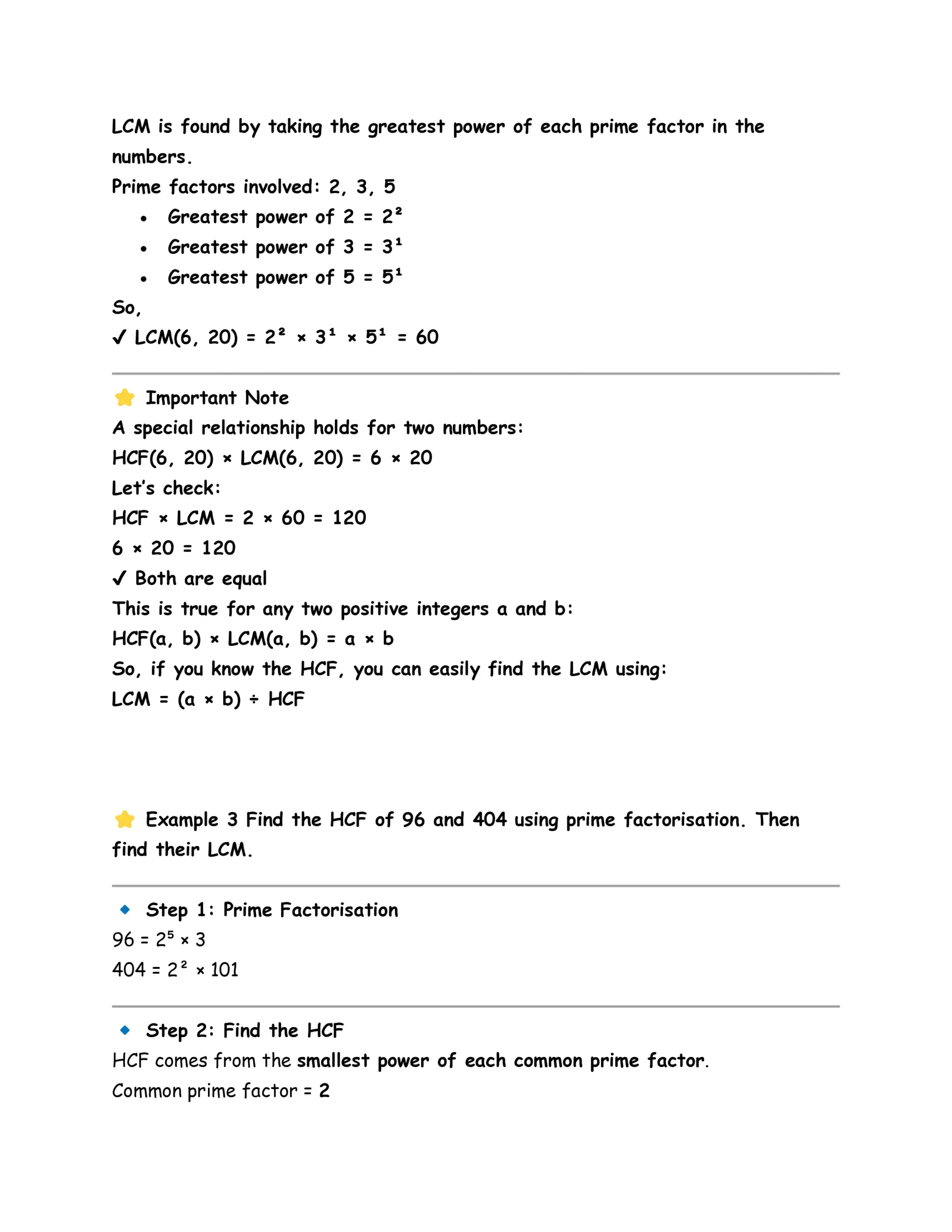
Important Note
A special relationship holds for two numbers:
$$\text{HCF}(6, 20) \times \text{LCM}(6, 20) = 6 \times 20$$
HCF × LCM = $2 \times 60 = 120$
$6 \times 20 = 120$ ✔
This is true for any two positive integers $a$ and $b$:
$$\text{HCF}(a, b) \times \text{LCM}(a, b) = a \times b$$
So, if you know the HCF, you can easily find the LCM using:
$$\text{LCM} = \dfrac{a \times b}{\text{HCF}}$$
⭐ Example 3
Find the HCF of 96 and 404 using prime factorisation. Then find their LCM.
Step 1: Prime Factorisation
$96 = 2^5 \times 3$
$404 = 2^2 \times 101$
Step 2: Find the HCF
HCF comes from the smallest power of each common prime factor. Common prime factor = 2
Power of 2 in 96 = $2^5$
Power of 2 in 404 = $2^2$
👉 Smallest power = $2^2$
$$\text{HCF}(96, 404) = 2^2 = 4$$
Step 3: Find the LCM using the formula
$$\text{LCM}(96,404) = \dfrac{96 \times 404}{\text{HCF}(96,404)}$$
Since HCF = 4:
$$\text{LCM}(96,404) = \dfrac{96 \times 404}{4}$$
$96 \div 4 = 24$ So:
$$\text{LCM} = 24 \times 404 = 9696$$
Final Answers
HCF = 4
LCM = 9696
⭐ Example 4
Find HCF and LCM of 6, 72 and 120.
Prime factorisation:
$6 = 2 \times 3$
$72 = 2^3 \times 3^2$
$120 = 2^3 \times 3 \times 5$
HCF (smallest powers of common primes)
Common primes: 2 and 3 $$\text{HCF} = 2^1 \times 3^1 = 6$$
LCM (highest powers of all primes)
$$\text{LCM} = 2^3 \times 3^2 \times 5^1 = 360$$
Important Remark
For three numbers, product of numbers ≠ HCF × LCM.
So: $6 \times 72 \times 120 \neq \text{HCF} \times \text{LCM}$ ❌ This special identity works only for two numbers.
⭐ 1.3 Revisiting Irrational Numbers (Easy Version)
In Class 9, you learned about irrational numbers — numbers that cannot be written in the form $\dfrac{p}{q}$ (where $p$ and $q$ are integers and $q \ne 0$).
Examples:
$\sqrt{2}, \sqrt{3}, \sqrt{5}, \pi, 0.101101110111\ldots$
In this section, we prove that numbers like $\sqrt{2}, \sqrt{3}, \sqrt{5}$ and in general $\sqrt{p}$ (where $p$ is prime) are irrational. To prove this, we use the Fundamental Theorem of Arithmetic.
⭐ Reminder: What is an irrational number?
A number $s$ is irrational if it cannot be written as:
$$s = \frac{p}{q}, \quad p, q \in \mathbb{Z},\ q \ne 0$$
⭐ Theorem 1.2 (Easy Explanation)
If $p$ is a prime and $p$ divides $a^2$, then $p$ also divides $a$.
Meaning:
If a prime number divides the square of a number, it must also divide the number itself.
Easy idea:
If you expand the prime factorisation of $a$:
$$a = p_1 p_2 \ldots p_n$$
Then,
$$a^2 = p_1^2 p_2^2 \ldots p_n^2$$
The only primes present in $a^2$ are the primes already present in $a$. So if a prime divides $a^2$, it must be one of those primes → it divides $a$.
⭐ Theorem 1.3: $\sqrt{2}$ is irrational
We use proof by contradiction.
Step 1: Assume $\sqrt{2}$ is rational ❌
So, we can write:
$$\sqrt{2} = \frac{r}{s}$$
where $r$ and $s$ are integers with no common factors (coprime).
Step 2: Square both sides
$$2 = \frac{r^2}{s^2}$$ So,
$$2s^2 = r^2$$
This means 2 divides $r^2$, so by Theorem 1.2: 👉 2 divides $r$ Let $r = 2c$ for some integer $c$.
Step 3: Substitute $r = 2c$
$$2s^2 = (2c)^2 = 4c^2$$
So,
$$s^2 = 2c^2$$
This means 2 divides $s^2$, so again by Theorem 1.2: 👉 2 divides $s$.
Step 4: Contradiction
We found that both $r$ and $s$ are even, so they have at least 2 as a common factor. But we started by assuming $r$ and $s$ are coprime. This is impossible.
Conclusion
Our assumption was wrong. So:
$$\sqrt{2} \text{ is irrational.}$$
⭐ Example 5: Prove that $\sqrt{3}$ is irrational
Same technique.
Step 1: Assume $\sqrt{3}$ is rational ❌
$$\sqrt{3} = \frac{a}{b}$$
with $a, b$ coprime.
Step 2: Square
$$3b^2 = a^2$$
This means 3 divides $a^2$, so by Theorem 1.2, 3 divides $a$. Let $a = 3c$.
Step 3: Substitute
$$3b^2 = 9c^2$$ So,
$$b^2 = 3c^2$$
Thus 3 divides $b$.
Step 4: Contradiction
Both $a$ and $b$ are divisible by 3 → they are not coprime. ✔ Conclusion: $\sqrt{3}$ is irrational.
⭐ Facts about Rational + Irrational Numbers
✔ Rational + Irrational = Irrational
✔ Rational − Irrational = Irrational
✔ Non-zero Rational × Irrational = Irrational
✔ Irrational ÷ Rational (non-zero) = Irrational
⭐ Example 6: Show that $5 - \sqrt{3}$ is irrational
Assume the opposite, that $5 - \sqrt{3}$ is rational:
$$5 - \sqrt{3} = \frac{a}{b}$$
Then,
$$\sqrt{3} = 5 - \frac{a}{b}$$
The right side is rational (difference of rationals). This means $\sqrt{3}$ would be rational.
❌ But we already proved $\sqrt{3}$ is irrational.
Conclusion
$$5 - \sqrt{3} \text{ is irrational.}$$
⭐ Example 7: Show that $\sqrt{3} \times \sqrt{2}$ is irrational
Assume it is rational:
$$\sqrt{3} \cdot \sqrt{2} = \frac{a}{b}$$
Then,
$$\sqrt{2} = \frac{a}{b\sqrt{3}}$$
Since $a$, $b$ and 3 are integers, this would mean $\sqrt{2}$ is rational.
❌ But $\sqrt{2}$ is irrational.
Conclusion
$$\sqrt{3} \cdot \sqrt{2} = \sqrt{6} \text{ is irrational.}$$