
🌟 Work, Energy and Power
In the earlier chapters, we learned how objects move, what causes motion, and how gravity works.
Now, we move to another very important idea in science called work.
Along with work, two closely connected concepts are energy and power.
These ideas help us understand many everyday and natural activities around us.
🍎 Why Do Living Beings Need Energy?
Every living being needs energy to survive.
From tiny insects to humans, everyone performs some basic activities every day.
These activities are called life processes.
For example, humans need energy for:
- Playing games ⚽
- Singing 🎶
- Reading and writing ✍️
- Thinking 🤔
- Jumping, cycling, and running 🚴♂️
Activities that are hard or tiring need more energy.
This energy comes mainly from the food we eat.
🐾 Energy in Animals
Animals also use energy all the time.
They need energy to:
- Run and jump
- Escape from enemies
- Fight or protect themselves
- Search for food
- Find a safe place to live
Some animals even help humans by:
- Carrying loads
- Pulling carts
- Ploughing fields
All these actions require energy.
⚙️ Energy and Machines
Now think about machines around you:
- Fan
- Bicycle
- Car
- Washing machine
- Pump
What do they all need to work?
They need energy.
Some machines use:
- Electricity (fan, TV, computer)
- Fuel like petrol or diesel (car, bike, tractor)
Just like living beings, machines cannot work without energy.
❓ Think & Answer
• Why do living beings need food?
• Why do cars need petrol or diesel?
• Can a machine work without energy?
👉 The answer is simple:
Energy is needed to do work, whether it is done by humans, animals, or machines.
✅ Key Takeaway
• Work is done when energy is used.
• Energy makes all activities possible.
• Power tells us how fast the work is done.
• Without energy, life and machines would come to a stop.
✨ In the next parts, we will understand work, energy, and power in detail with easy examples from daily life.
🔹 10.1 Work
In science, the meaning of work is different from daily life.
Feeling tired or busy does not always mean work is done in science.
🔸 10.1.1 NOT MUCH ‘WORK’ IN SPITE OF WORKING HARD!
📚 Kamali studies all day for exams.
She reads, writes, draws diagrams, and attends classes.
She uses a lot of energy, so in daily life we say she is working hard.
👉 But in science, very little or no work is done.
🪨 Pushing a big rock that does not move
You get tired 😓, but the rock stays still.
👉 No work is done because there is no movement.
🎒 Standing with a load on the head
You feel tired, energy is spent.
👉 Still no work in science.
🏃♂️ Climbing stairs or a tree
Your body moves upward.
👉 Work is done according to science.
🔸 10.1.2 Scientific Meaning of Work
🪨 Pushing a pebble and it moves
🛒 Pulling a trolley and it moves
📖 Lifting a book upward
In all these cases, work is done.
🧠 Two Conditions for Work (Science)
✅ Force is applied
✅ Object moves (displacement)
If any one is missing ❌ → No work is done
🐂 Bullock pulling a cart
Force + movement = Work is done ✔️
🌟 Main Point
🔹 Daily life work ≠ Science work
🔹 Force + Movement = Work
🔹 No movement → No work, even if you feel tired 😴
🔹 10.1.3 Work Done by a Constant Force
To understand work in science, first look at a simple case where force and movement are in the same direction.
📦 Force and Displacement
• A constant force (F) acts on an object.
• The object moves a distance (s) in the same direction.
👉 Work done (W) is defined as:
W = Force × Displacement
W = F × s
Work depends on how strong the force is and how far the object moves.
📏 Unit of Work
• Unit of work = joule (J)
• 1 joule = work done when
o Force = 1 newton (N)
o Displacement = 1 metre (m)
🧠 Example:
If F = 1 N and s = 1 m
👉 Work done = 1 J
🚫 When Is Work Zero?
❌ If force = 0 → no work
❌ If displacement = 0 → no work
(Force + movement are both needed ✔️)
➕ Positive Work
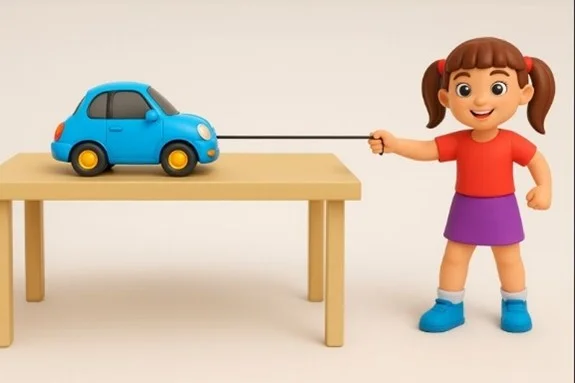
👶 A baby pulls a toy car forward
• Force and movement are in the same direction
👉 Work done is positive
➖ Negative Work
🛑 An object is moving, but a force acts opposite to motion
Example: brakes slowing a moving car
• Angle between force and motion = 180°
👉 Work done is negative
🌟 Main Point
🔹 Work = Force × Displacement
🔹 Unit of work is joule (J)
🔹 Same direction → positive work
🔹 Opposite direction → negative work
🔹 No force or no movement → no work
🤔 Intext Questions 🤔
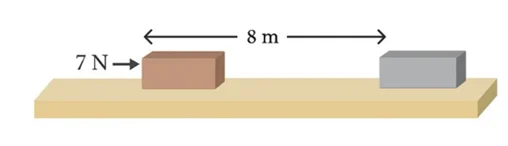
Q1. A force of 7 N acts on an object. The displacement is, say 8 m, in the direction of the force (Diagram). Let us take it that the force acts on the object through the displacement. What is the work done in this case?
Answer:
🧱 Given:
Force = 7 N
Displacement = 8 m
Direction of force and movement = same ➡️
✏️ Formula:
Work (W) = Force × Displacement
🧮 Calculation
W = 7 × 8
W = 56 J
✅ Answer
🔹 Work done = 56 joules (J)
🌟 Main Point
Same direction force + movement → positive work ➕
Unit of work = joule (J)
🔹 10.2 Energy
🌍 Life is impossible without energy.
Every day, the need for energy is increasing.
☀️ Sources of Energy
Sun ☀️ is the biggest natural source of energy.
Many energy sources come from the Sun.
Energy also comes from:
⚛️ Nuclei of atoms
🌋 Inside the Earth
🌊 Tides
👉 Can you think of more energy sources around you?
⚡ What Is Energy?
In daily life, we use the word energy often.
In science, energy means the capacity to do work.
Let us see some examples 👇
- 🏏 A fast cricket ball hits a wicket → wicket falls
- 🔨 A raised hammer falls on a nail → nail goes into wood
- 🚗 A wound-up toy car starts moving
- 🎈 A pressed balloon changes shape or may burst
In all these cases, objects have the ability to do work.
This ability is called energy.
🔄 Energy Transfer
The object doing work loses energy.
The object on which work is done gains energy.
An object with energy can:
- Apply force
- Transfer energy to another object
- Make the other object move and do work
📏 Unit of Energy
Unit of energy = joule (J)
1 J = energy needed to do 1 J of work
Larger unit:
1 kilojoule (kJ) = 1000 J
🌟 Main Point
🔹 Energy = capacity to do work
🔹 Energy can be transferred from one object to another
🔹 Unit of energy is joule (J)
🔹 Without energy, no work is possible 🚫
🔹 10.2.1 Forms of Energy
🌍 Energy is available around us in many forms.
Some common forms of energy are:
- ⚙️ Mechanical Energy
- Potential Energy
- Kinetic Energy
- 🔥 Heat Energy
- 🧪 Chemical Energy
- ⚡ Electrical Energy
- 💡 Light Energy
All these forms help us do different kinds of work in daily life.
🔹 10.2.2 Kinetic Energy
🚗 Any moving object can do work.
An object moving faster can do more work than the same object moving slowly.
Examples of moving objects with kinetic energy:
- 🥥 A falling coconut
- 🚘 A speeding car
- 🪨 A rolling stone
- ✈️ A flying aircraft
- 🌊 Flowing water
- 🌬️ Blowing wind
- 🏃♂️ A running athlete
👉 Energy due to motion is called kinetic energy.
⚡ What Is Kinetic Energy?
🧠 Kinetic energy is the energy possessed by an object because of its motion.
More speed → more kinetic energy 📈
📘 Definition (Scientific)
The kinetic energy of a body is equal to the work done on it to bring it to that speed.
🧮 Derivation (Short & Simple)
Let:
Mass of object = m
Initial velocity = u
Final velocity = v
From equations of motion:
v² − u² = 2as
Work done:
W = F × s
If the object starts from rest (u = 0):
📐 Formula of Kinetic Energy
We know that work done is equal to the change in the kinetic energy of an object.
🌟 Main Point
🔹 Kinetic energy is due to motion
🔹 Faster object → more kinetic energy
🔹 Unit of kinetic energy = joule (J)
🔹 Formula: \( E_k = \frac{1}{2} mv^2 \)
📌 Intext questions📌
Q.1: What is the kinetic energy of an object?
Answer:
⚡ Kinetic energy is the energy possessed by an object due to its motion.
👉 Any moving object has kinetic energy.
Q.2: Write an expression for the kinetic energy of an object.
📐 The formula for kinetic energy is:
Where:
m = mass of the object
v = velocity of the object
Q.3: The kinetic energy of an object of mass, m moving with a velocity of 5 m s−1 is 25 J. What will be its kinetic energy when its velocity is doubled? What will be its kinetic energy when its velocity is increased three times?
Answer:
🧮 Given:
Mass = m
Initial velocity = 5 m s−1
Kinetic energy = 25 J
Since,
\( E_k \propto v^2 \)
🚀 Case 1: Velocity is doubled
New velocity = 2 × 5 = 10 m s−1
When velocity is doubled: (2)2 = 4
So, kinetic energy becomes 4 times:
🚀 Case 2: Velocity is increased three times
New velocity = 3 × 5 = 15 m s−1
When velocity is tripled: (3)2 = 9
So, kinetic energy becomes 9 times:
🌟 Main Point
🔹 Kinetic energy does not increase linearly with speed
🔹 Speed × 2 → Energy × 4
🔹 Speed × 3 → Energy × 9
🔹 This is because \( E_k = \frac{1}{2} mv^2 \)
🔹 10.2.3 Potential Energy
🔋 Sometimes energy is stored in an object and used later.
This stored energy is called potential energy.
🧪 Activity : Rubber Band
🟡 Stretch a rubber band and release one end.
➡️ It quickly comes back to its original shape.
👉 When stretched, the rubber band stores energy.
👉 This energy is stored because of its changed shape.
🧪 Activity : Slinky
🌀 Stretch a slinky and then release it.
➡️ It moves back to its original position.
👉 The slinky gains energy when stretched.
👉 Yes, it also gains energy when compressed.
🧪 Activity : Toy Car
🚗 Wind a toy car using its key and place it on the floor.
➡️ The car starts moving.
👉 Energy is stored in the spring inside the car.
👉 More windings = more stored energy
👉 You can test this by winding it more times and seeing how far it goes.
🧪 Activity : Lifted Object
📦 Lift an object to a height and release it.
➡️ It falls down and can do work.
👉 When lifted higher, it can do more work.
👉 The energy comes from the work done by you.
🧠 Understanding Potential Energy
Energy gets stored when work is done on an object
If energy is not used to change speed, it gets stored
This stored energy is called potential energy
📌 Examples:
Stretched rubber band
Compressed slinky
Wound toy car spring
Object kept at a height
🌟 Main Point
🔹 Potential energy = stored energy
🔹 It depends on position or shape
🔹 Energy is stored due to work done on the object
🔹 Stored energy can later be used to do work
🔹 10.2.4 Potential Energy of an Object at a Height
📦 When an object is lifted upward, its energy increases.
This happens because we do work against gravity.
👉 The energy gained by an object due to its height above the ground is called gravitational potential energy.
⬆️ Why Does Energy Increase?
Gravity pulls objects downward 🌍
To lift an object, we must apply force against gravity
The work done is stored as potential energy
📘 Definition
🧠 Gravitational potential energy is the work done in lifting an object from the ground
to a certain height against gravity.
🧮 Formula
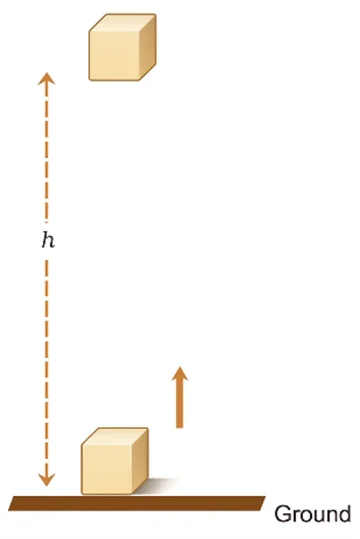
Let:
Mass of object = m
Height raised = h
Acceleration due to gravity = g
Work done:
W = Force × Displacement
Minimum force needed = weight = mg
W = mg × h = mgh
So,
Ep = mgh
🛣️ Does Path Matter?
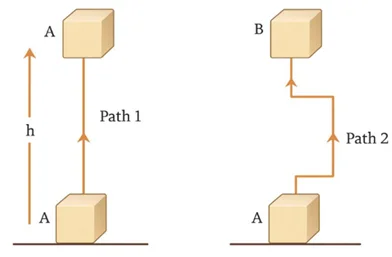
🚶♂️ Whether the object is lifted:
straight up ⬆️
or along a zig-zag path 🔀
👉 If the final height is the same, potential energy gained is the same.
✔️ Only vertical height matters, not the path.
ℹ️ More to Know
📏 Potential energy depends on the reference level (ground level).
Same object can have different potential energy
Depends on which level is taken as zero
🌟 Main Point
🔹 Lifting an object stores energy
🔹 Stored energy due to height = potential energy
🔹 Formula: Ep = mgh
🔹 Depends on height, not the path
🔹 Reference level matters
🔹 10.2.5 Are Various Energy Forms Interconvertible?
🔄 Yes! Energy can be converted from one form to another.
In nature and daily life, we see energy conversion happening all the time.
🌿 Activity : Energy Conversion in Nature
Discuss these examples 👇
🌱 (a) How do green plants produce food?
Sunlight ☀️ → Chemical energy 🍃
Process: Photosynthesis
☀️ (b) Where do plants get energy from?
From the Sun
🌬️ (c) Why does air move from place to place?
Uneven heating by the Sun
Heat energy → Kinetic energy (wind)
🪨 (d) How are fuels like coal and petroleum formed?
Stored solar energy in plants 🌞
Converted into chemical energy over millions of years
🌊 (e) Water cycle energy conversion
Sun’s heat → evaporation
Potential energy (clouds) → kinetic energy (rain)
⚙️ Activity : Energy Conversion in Daily Life
Some common examples 👇
💡 Electric bulb:
Electrical energy → Light + Heat
🌀 Fan:
Electrical energy → Kinetic energy
🚗 Car:
Chemical energy (fuel) → Kinetic energy
🔋 Mobile phone:
Chemical energy (battery) → Electrical → Light/Sound
🏃♂️ Human body:
Chemical energy (food) → Kinetic energy
🌟 Main Point
🔹 Energy can change from one form to another
🔹 Energy is never destroyed, only converted
🔹 Nature and machines work because of energy conversion
🔹 Sun is the main source of energy on Earth ☀️
🔹 10.2.6 Law of Conservation of Energy
🔄 From earlier activities, we saw that energy can change its form.
But an important question is:
👉 What happens to the total energy?
📜 Law of Conservation of Energy
⚖️ Energy can neither be created nor destroyed. It can only be converted from one form to another.
✔️ Total energy remains constant before and after conversion.
✔️ This law is valid always and everywhere.
📦 Simple Example: Falling Object
Consider an object of mass m falling freely from height h.
🔹 At the top:
Velocity = 0
Kinetic energy = 0
Potential energy = mgh
👉 Total energy = mgh
🔹 During fall:
Height decreases ⬇️
Speed increases 🚀
Potential energy ↓
Kinetic energy ↑
Kinetic energy at any instant:
E_k = 1/2 mv^2
🔹 Just before touching ground:
Height ≈ 0
Speed is maximum
Potential energy ≈ 0
Kinetic energy is maximum
📐 Energy Balance At any point during fall:
"Potential Energy" + "Kinetic Energy" = "Constant"
mgh + 1/2 mv^2 = "constant"
⚙️ Mechanical Energy
🧠 Mechanical energy = 👉 Potential energy + Kinetic energy
During free fall:
Potential energy converts into kinetic energy
Total mechanical energy remains same (Air resistance is ignored)
🌟 Main Point
🔹 Energy is never lost, only transformed
🔹 Total energy of a system stays constant
🔹 In free fall: PE ↓ → KE ↑
🔹 Mechanical energy remains conserved
🔹 10.3 Rate of Doing Work (Power)
⚡ Do all people and machines work at the same speed?
No. Some do work faster, some slower.
Man 🚶♂️ vs Car🚗 Understanding Power
A strong person can do the same work in less time
A powerful vehicle reaches faster than a less powerful one
👉 The speed of doing work is called power.
📘 Definition of Power:
🧠 Power is the rate of doing work or the rate of transfer of energy.
"Power"="Work" /"Time"
P=W/t
📏 Unit of Power
Unit of power = watt (W)
Named after James Watt
📌 1 watt means:
1 joule of work done in 1 second
1 W = 1 J s−1
⚙️ Bigger Units
1 kilowatt (kW) = 1000 W
1 kW = 1000 J s−1
🔄 Average Power
⏱️ Sometimes power changes with time.
So we use average power.
🧠 Average power = Total energy used ÷ Total time taken
🤔 Intext Questions 🤔
Q.1: What is power?
⚡ Power is the rate of doing work.
Q.2: Define 1 watt of power.
🔹 1 watt is the power when 1 joule of work is done in 1 second.
Q.3: A lamp consumes 1000 J of electrical energy in 10 s. What is its power?
P=1000/10=▭(100" " W)
Q.4: What is average power?
🔹 Average power is the total energy consumed divided by total time.
🌟 Main Point
🔹 Power tells how fast work is done
🔹 Unit of power is watt (W)
🔹 More power → less time
🔹 Average power is used when power changes with time.