
Chapter 11: Sound (Notes)
11.0 Introduction
🌍 Sounds Around Us
Every day, we hear sounds from many different sources such as humans, birds, bells, machines, vehicles, televisions, radios, and many others. Sound plays an important role in our daily life, as it helps us communicate and stay aware of our surroundings.
⚡ What Is Sound?
Sound is a form of energy that produces the sensation of hearing in our ears.
There are many forms of energy, for example:
- Mechanical energy
- Light energy
- Heat energy
- Sound energy
🔁 Law of Conservation of Energy
It can only be converted from one form to another.
👏 Sound and Energy
When you clap your hands, a sound is produced. Now think about this:
- Can sound be produced without using energy?
- Which form of energy is used to produce sound?
👉 When we clap, mechanical energy (movement of hands) is converted into sound energy. So, sound is always produced due to the use and conversion of energy.
📘 What Will We Learn in This Chapter?
- How sound is produced
- How sound travels through a medium
- How sound reaches our ears
- How we are able to hear sound
⭐ Key Points (Quick Revision)
- Sound is a form of energy
- Sound produces the sensation of hearing
- Sound cannot be produced without energy
- Energy changes its form, it is never destroyed
11.1 Production of Sound
🔹 How Is Sound Produced?
Sound is produced when an object vibrates. These vibrations cause the surrounding particles of the medium (air, water, or solid) to vibrate, which finally reaches our ears as sound.
🧪 Activity 11.1: To Show That Sound Is Produced by Vibrations
🎯 Aim
To show that sound is produced due to vibrations.
🧰 Materials Required
- A tuning fork
- A rubber pad
- A table tennis ball (or small plastic ball)
- A thread
- A support stand
📝 Procedure
- Take a tuning fork and strike its prong gently on a rubber pad to set it vibrating.
- Bring the vibrating tuning fork near your ear.
- Observe: Do you hear any sound?
- Now touch one prong of the vibrating tuning fork with your finger.
- Observe: What do you feel?
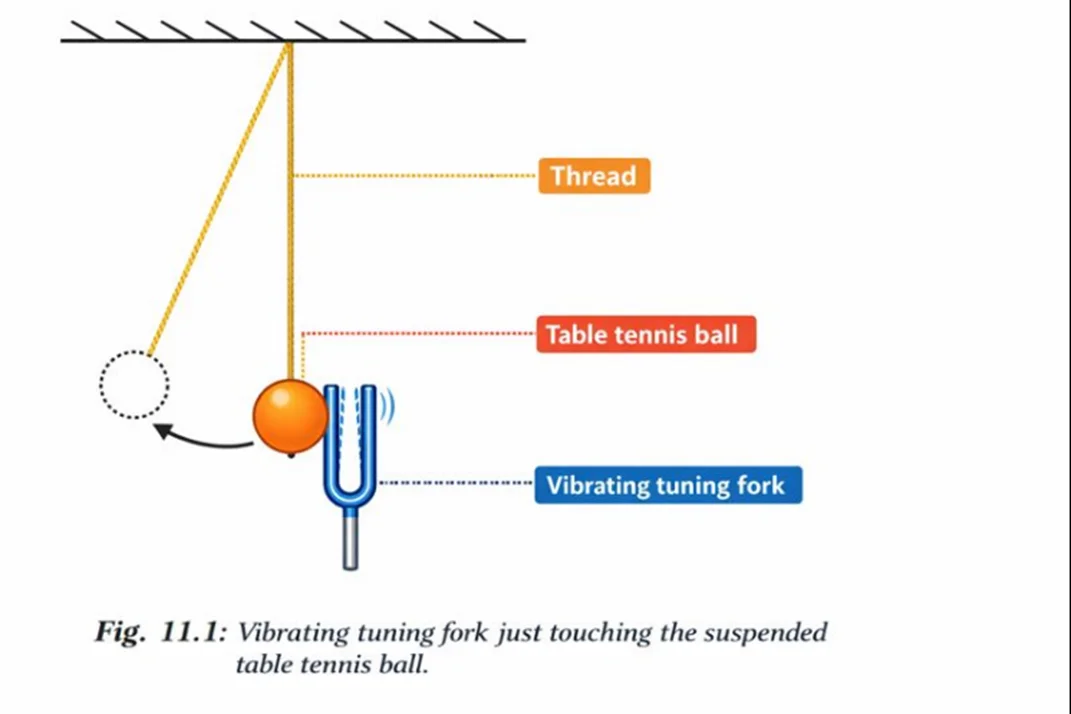
- Suspend a table tennis ball using a thread from a support.
- Gently touch the suspended ball with the prong of the vibrating tuning fork.
- Observe the motion of the ball carefully.
👀 Observations
- A clear sound is heard when the tuning fork is vibrating.
- When the vibrating prong is touched, vibrations stop and the sound also stops.
- The suspended table tennis ball moves away suddenly when touched by the vibrating tuning fork.
🧠 Explanation
- When the tuning fork is struck, it starts vibrating.
- These vibrations produce sound.
- When we touch the prong, vibrations stop, so the sound also stops.
- The vibrating tuning fork pushes the table tennis ball, showing that the fork was actually moving back and forth.
👉 This proves that sound is produced due to vibrations of objects.
✅ Conclusion
Sound is produced only when an object vibrates.
⭐ Key Points for Exam
- Sound is a form of energy produced by vibrations.
- Vibrating objects transfer energy to surrounding particles.
- Tuning fork experiment proves that vibration is necessary for sound.
🤔 Did You Know?
- Even when we cannot see vibrations clearly, they still exist.
- Loud sounds are produced by strong vibrations, while soft sounds are produced by weak vibrations.
11.2 Production of Sound
🧪 Activity 11.2: Sound Is Produced Due to Vibrations
🎯 Aim
To show that sound cannot be produced without a vibrating object and that vibrations can be seen indirectly.
🧰 Materials Required
- A tuning fork
- A glass or beaker
- Water
📝 Procedure
- Fill a glass or beaker with water up to the brim.
- Strike a tuning fork gently on a rubber pad to make it vibrate.
- Touch one prong of the vibrating tuning fork lightly on the water surface (Fig.).
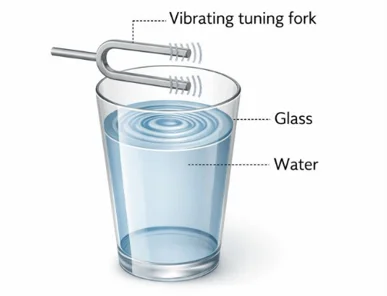
- Observe what happens to the water.
- Now dip both prongs of the vibrating tuning fork into the water (Fig.).
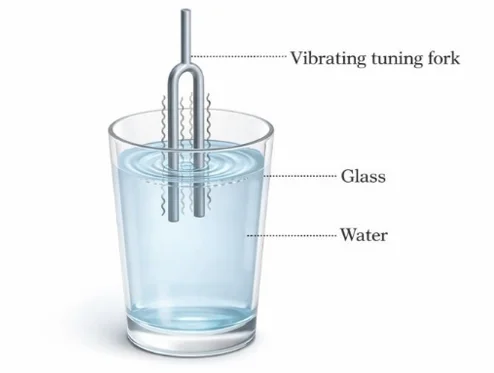
- Observe again and compare both cases.
- Discuss your observations.
👀 Observations
- When one prong touches the water, small ripples and splashes are produced.
- When both prongs are dipped in water, the water shows stronger splashing and disturbance.
- Sound is heard clearly in both cases.
🧠 Explanation (Interesting & Easy)
- When the tuning fork vibrates, its prongs move rapidly to and fro.
- A vibrating prong pushes water particles, creating ripples and splashes.
- With both prongs in water, more energy transfers, so disturbance is stronger.
- Water makes vibrations visible, even if we can’t easily see prongs vibrating in air.
✅ Conclusion
- Sound is produced only when an object vibrates.
- No vibration means no sound.
- So, sound cannot be produced without a vibrating object.
🔁 Other Ways of Producing Sound
- Plucking (string instruments, rubber band)
- Scratching
- Rubbing
- Blowing (flute, whistle)
- Shaking (bells, rattles)
- In all these cases, the object is set into vibration.
🔍 What Is Vibration?
Vibration is a rapid to-and-fro motion of an object about its mean position.
🧍 Sound in Living Beings
- Human voice is produced due to vibrations of the vocal cords.
- The buzzing sound of a bee is produced due to vibration of its wings.
- When a bird flaps its wings, vibrations are produced, which may create sound.
- A stretched rubber band vibrates and produces sound when plucked.
⭐ Key Points for Exams
- Sound is produced by vibrating objects.
- Vibrations transfer energy to surrounding particles.
- Water experiments help us see vibrations clearly.
- All sound-producing actions involve vibration.
🤔 Did You Know?
- Loud sounds are produced by strong vibrations, while soft sounds come from weak vibrations.
- Even when we cannot see vibrations, they still exist and produce sound.
11.3 Musical Instruments and Vibrations
🧪 Activity 11.3: Vibrating Parts of Musical Instruments
🎯 Aim
To identify different musical instruments and understand which part of each instrument vibrates to produce sound.
📝 Activity
Make a list of different types of musical instruments and discuss which part of the instrument vibrates to produce sound.
🎶 List of Musical Instruments and Their Vibrating Parts
| Musical Instrument | Vibrating Part That Produces Sound |
|---|---|
| Guitar | Strings |
| Violin | Strings |
| Sitar | Strings |
| Tabla | Stretched membrane (skin) |
| Drum | Stretched membrane |
| Flute | Air column inside the flute |
| Whistle | Air column |
| Shehnai | Air column |
| Harmonium | Air column (reed vibration) |
| Bell | Metal body of the bell |
| Cymbals | Metal plates |
| Piano | Strings |
🧠 Explanation
- Musical instruments produce sound when some part of the instrument vibrates.
- In string instruments, sound is produced due to vibration of strings.
- In drum-like instruments, a stretched membrane vibrates.
- In wind instruments, vibration of the air column produces sound.
- In solid instruments like bells, the entire body vibrates.
- Although the instruments look different, vibration is common to all.
✅ Conclusion
All musical instruments produce sound due to vibrations of some part of the instrument.
Different instruments have different vibrating parts, but the basic principle remains the same.
⭐ Key Points for Exams
- Sound is always produced by vibrating objects.
- Strings, membranes, air columns, or solid bodies may vibrate.
- Without vibration, no musical sound can be produced.
🤔 Did You Know?
- When you stop the vibration of a guitar string with your finger, the sound stops immediately.
- In wind instruments, you are not vibrating the instrument directly, but the air inside it.
11.2 Propagation of Sound
🔹 What Is Propagation of Sound?
Sound is produced by vibrating objects. The substance through which sound travels is called a medium.
👉 A medium can be:
- Solid
- Liquid
- Gas
🔹 How Does Sound Travel Through a Medium?
When an object vibrates, it sets the particles of the surrounding medium into vibration.
Important points to understand:
- The particles of the medium do not move from the source to the ear.
- Only the disturbance (energy) travels through the medium.
- Each particle vibrates about its mean (equilibrium) position and transfers energy to the next particle.
- This process continues until the sound reaches our ears.
🌊 Sound as a Wave
A wave is a disturbance that moves through a medium when the particles of the medium set neighbouring particles into motion.
- The particles themselves do not travel forward.
- Only the disturbance is carried forward.
👉 Therefore, sound travels in the form of a wave.
⚙️ Mechanical Waves
Sound waves require a material medium to travel, so they are called mechanical waves.
🌬️ Sound Waves in Air (Compressions and Rarefactions)
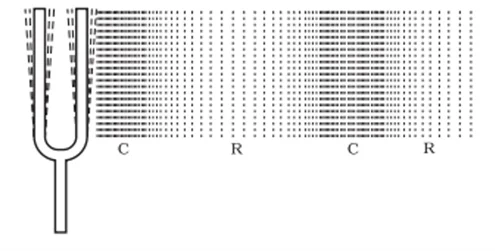
Air is the most common medium for sound propagation.
🔸 Compression (C)
- When a vibrating object moves forward, it pushes air particles.
- This creates a region of high pressure and high density.
- This region is called compression (C).
🔸 Rarefaction (R)
- When the vibrating object moves backward, air particles move apart.
- This creates a region of low pressure and low density.
- This region is called rarefaction (R).
🔁 Formation of a Sound Wave
As the object vibrates back and forth rapidly:
- A series of compressions and rarefactions is produced.
- These alternate regions travel through the medium.
- Together, they form a sound wave.
📊 Pressure and Density Variations
- Pressure depends on the number of particles per unit volume.
- High particle density → high pressure (Compression)
- Low particle density → low pressure (Rarefaction)
👉 Thus, sound propagation can be visualised as the propagation of pressure or density variations in the medium.
✅ Key Conclusions
- Sound needs a medium to travel.
- Sound travels as a longitudinal wave in air.
- Compressions and rarefactions carry sound energy forward.
- Particles only vibrate; they do not travel with the wave.
🤔 Did You Know?
- Sound travels fastest in solids, slower in liquids, and slowest in gases.
- In outer space (vacuum), sound cannot travel because there is no medium.
📌 Intext Questions 📌
Q.1 How does the sound produced by a vibrating object in a medium reach your ear?
✅ Answer
Sound produced by a vibrating object reaches our ear through the vibrations of particles of the medium.
🧠 Explanation
- When an object vibrates, it sets the particles of the surrounding medium (such as air) into vibration.
- These particles transfer energy to neighbouring particles by creating compressions and rarefactions.
- The disturbance travels through the medium and finally reaches the eardrum.
- Particles do not travel from source to ear; only sound energy travels.
🤔 Did You Know?
Sound can travel through solids, liquids, and gases, but it cannot travel in vacuum.
Q.2 Explain how sound is produced by your school bell.
✅ Answer
Sound is produced by the vibration of the bell.
🧠 Explanation
- When the bell is struck, it vibrates rapidly.
- These vibrations make nearby air particles vibrate.
- Compressions and rarefactions travel as sound waves to our ears.
🤔 Did You Know?
If you touch the bell immediately after it rings, you can feel vibrations.
Q.3 Why are sound waves called mechanical waves?
✅ Answer
Sound waves are called mechanical waves because they require a material medium to travel.
🧠 Explanation
- Sound travels by mechanical vibration of particles of the medium.
- So a medium (air, water, solids) is necessary.
- Without medium, sound cannot travel.
🤔 Did You Know?
Light waves do not need a medium, so they are not mechanical waves.
Q.4 Suppose you and your friend are on the Moon. Will you be able to hear any sound produced by your friend?
✅ Answer
No, sound cannot be heard on the Moon.
🧠 Explanation
- The Moon has no atmosphere (no air).
- Sound needs a medium, so it cannot travel in vacuum.
- So your friend’s sound will not reach your ear.
🤔 Did You Know?
Astronauts communicate on the Moon using radio signals.