
Class 9 Science Unit 9 Notes – Gravitation (NCERT Based)
Study Class 9 Science Gravitation Notes (NCERT Based) with simple explanations, key formulas, solved numericals, and important definitions. Perfect for CBSE exam revision, school tests, and quick last-minute prep. Includes intext questions with answers, examples, and concept clarity on G, g, free fall, mass and weight, pressure in fluids, buoyancy and Archimedes’ principle.
🔹 Introduction: Gravitation
🌟 Why Do Things Move the Way They Do?
We already learned that objects move because of force.
A force is needed to change the speed or direction of any moving object.
✅ Daily Life Examples
- When you drop something from a height, it falls towards the Earth 🌏
- Planets move around the Sun ☀️
- The Moon moves around the Earth 🌙
These natural motions happen because a force is acting on them.
🧲 Newton’s Big Idea
Isaac Newton realised something amazing:
✅ The same force that pulls an apple downwards also keeps the Moon and planets in their orbits.
This invisible pull is called gravitational force.
📘 What You Will Learn in This Chapter
In this chapter, you will explore:
1. 🌐 Gravitation
What it is and how it works everywhere in the universe.
🤔 Did You Know?
If gravity took a day off, you would not “jump”... you would just keep floating like a confused balloon looking for Wi-Fi.
2. ⚖️ Universal Law of Gravitation
The rule that explains attraction between any two objects.
🤔 Did You Know?
Everything attracts everything, even you and your school bag. The only reason it does not fly into your arms is because the force is super tiny… like your “I will study from tomorrow” motivation.
3. ⬇️ Motion under Gravity
How objects move when Earth’s gravity acts on them.
🤔 Did You Know?
A feather falls slower than a stone not because gravity likes stones more… it’s because air gives the feather extra “brakes.” In space, both fall together like best friends.
4. 📉 Weight Variations
Why your weight changes from place to place, but your mass stays the same.
🤔 Did You Know?
Your mass stays the same everywhere, but your weight changes. So technically, on the Moon you are not “thin”… you are just on a planet with weaker gravity. Instant glow-up.
5.🛶 Floating and Sinking
Why objects float or sink in liquids and what conditions affect this.
🤔 Did You Know?
Huge ships float, but a small coin sinks. It’s not about size, it’s about “smart shape” and density. Water basically says: “If you spread your weight nicely, I’ll support you.”
⭐ 9.1 Gravitation
🌙 Why Doesn’t the Moon Fall?
We know the Moon goes around the Earth.
When you throw an object upward, it rises to a certain height and then comes back down because Earth pulls it.
A similar question once puzzled Isaac Newton.
One day, while sitting under a tree, an apple fell near him 🍎. Newton started thinking:
- • If Earth can pull an apple down, can it also pull the Moon?
- • Is the same force acting in both cases?
✅ Newton’s Key Idea
Newton imagined something important:
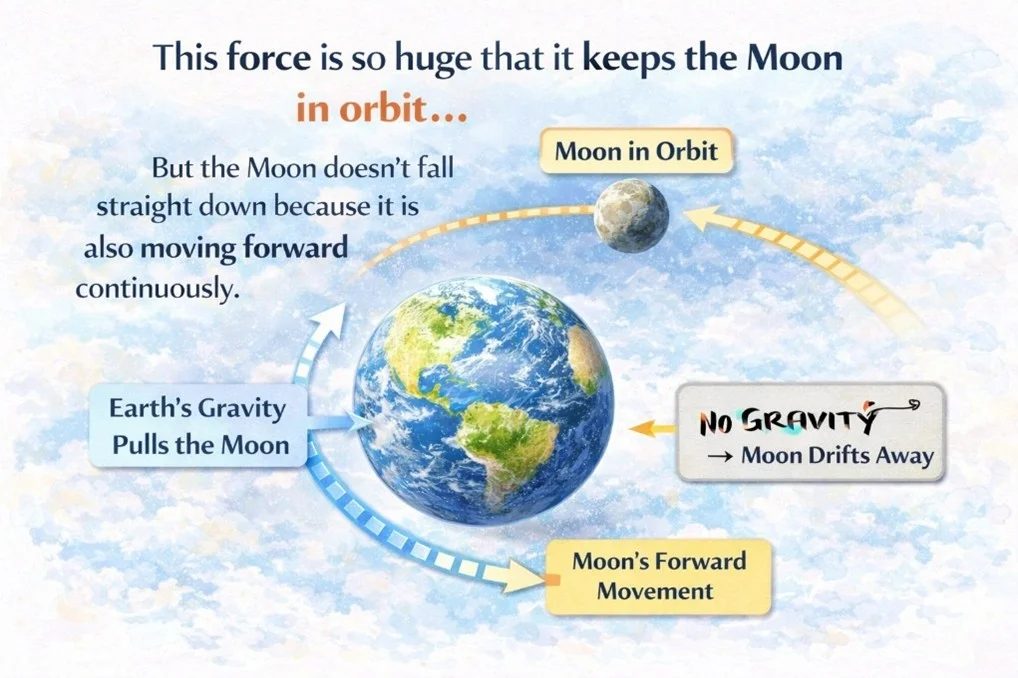
At every point in its orbit, the Moon is actually falling towards the Earth.
But at the same time, it has a forward motion, so it keeps moving ahead instead of falling straight down.
So the Moon does not crash into Earth because:
- • Gravity pulls it inward (towards Earth)
- • The Moon’s forward speed keeps it moving ahead
👉 This balance makes the Moon follow a curved path called an orbit.
🎯 One-line Memory
Orbit = continuous falling + forward motion
🤔 Did You Know?
If the Moon suddenly stopped moving forward, it would not stay in orbit.
It would start falling towards Earth like a dropped stone… just from very, very far away.
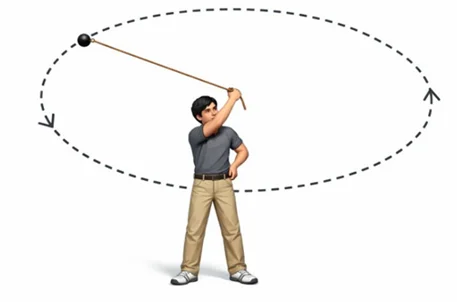
🎡 Activity 9.1 – Understanding Circular Motion
🧪 What to Do
- • Take a thread and tie a small stone to one end.
- • Hold the other end and whirl the stone in a circular path.
- • Observe how the stone moves.
- • Now release the thread.
- • Watch the new direction of the stone’s motion.
🧠 What You Observe
- • Before releasing the thread, the stone moves in a circle with a certain speed.
- • It keeps changing direction at every point of the circle.
- • Changing direction = changing velocity, so the stone is accelerating.
- • A force is needed for this acceleration.
- • This force always acts towards the centre of the circle.
- • This centre-seeking force is called centripetal force.
✅ When the thread is released:
- • The centripetal force becomes zero.
- • So the stone flies off in a straight line, along a direction called the tangent to the circular path.
🌍 Moon’s Motion Explained
The Moon keeps moving around the Earth because it needs a centripetal force.
✅ This centripetal force is provided by Earth’s gravitational pull.
If gravity did not exist, the Moon would move in a straight line and drift away into space.
🤔 Did You Know?
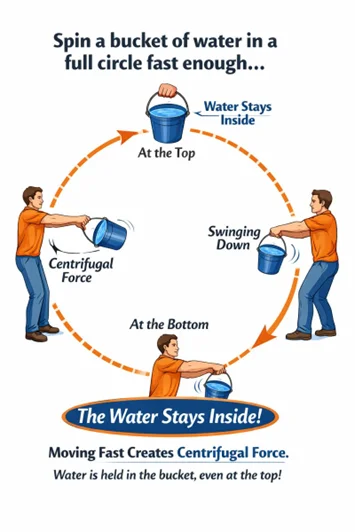
If you spin a bucket of water in a full circle fast enough, the water doesn’t fall out at the top.
That’s because it also needs a centre-seeking force, just like the stone and the Moon. Physics is basically “don’t let things fly away.”
🍎 Does the Apple Pull the Earth?
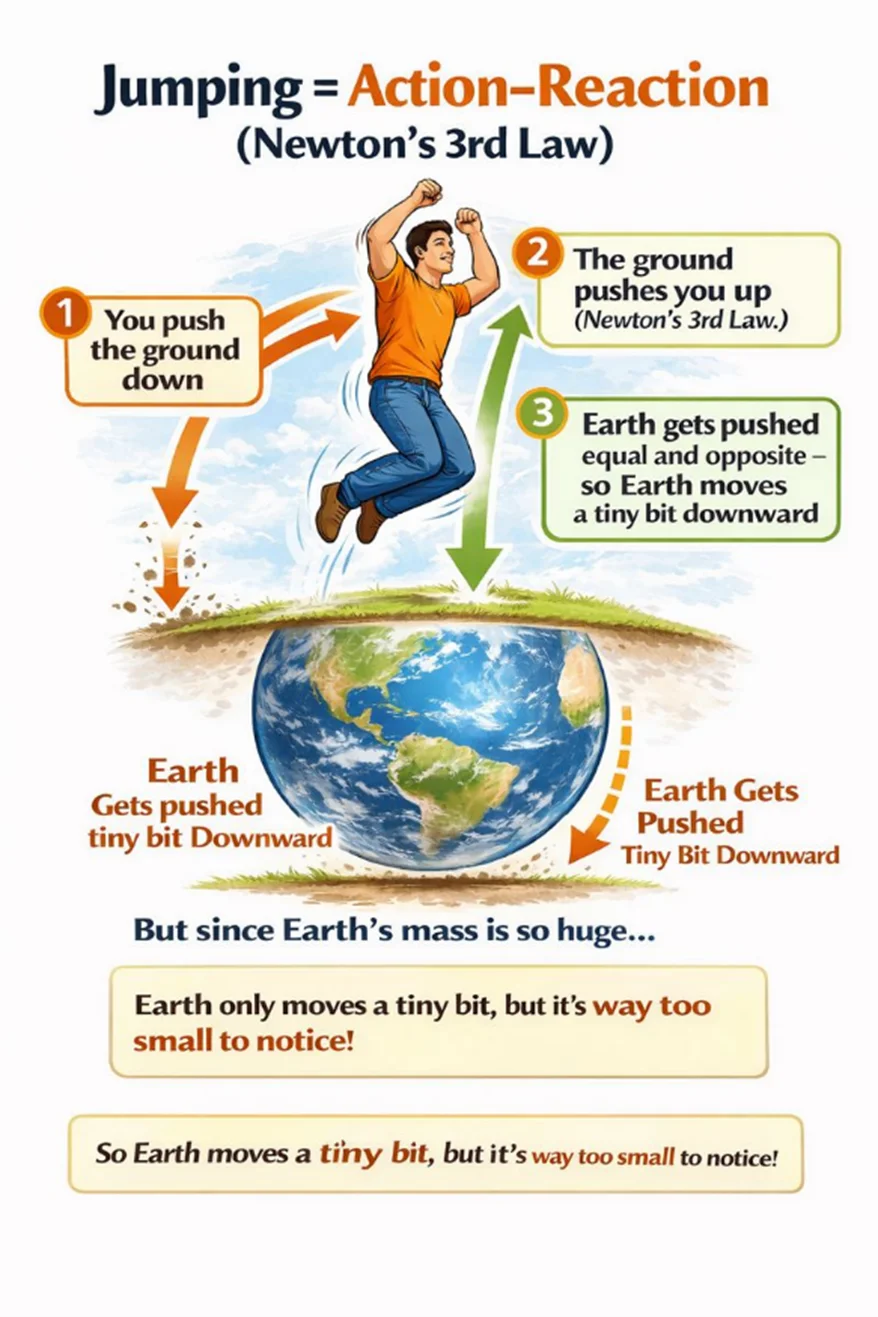
When an apple falls, Earth pulls the apple down.
But a good question is:
Does the apple pull the Earth too?
✅ Yes, it does.
Why?
Newton said:
If one object pulls another, the other object also pulls back.
So the apple pulls Earth, and Earth pulls the apple.
Then why don’t we see Earth moving?
Because Earth is very heavy (very big mass).
- Big mass means very small movement.
- So Earth’s movement toward the apple is so tiny that we can’t notice it.
The same reason explains why Earth does not move clearly toward the Moon.
🤔 Did You Know?
When you stand on the ground, you pull Earth up a little, and Earth pulls you down.
Earth is just too heavy, so its movement is almost zero.
☀️ What About the Planets?
Planets move around the Sun.
So there must be a force that:
- pulls the planets toward the Sun
- and keeps them moving in a circle
Newton said:
✅ Every object in the universe pulls every other object.
This pulling force is called gravity (gravitational force).
🤔 Did You Know?
If there was no gravity, the planets would not go in a circle.
They would move in a straight line and go far away into space.
🌌 9.1.1 Universal Law of Gravitation
🌟 What Newton Discovered
Newton stated something powerful:
Every object in the universe attracts every other object.
This attraction (or pull or Gravity) depends on two things:
- More mass → more gravitational force
- More distance → less gravitational force
In simple words:
Gravity increases with mass 🪨🪨
Gravity decreases with distance 📏
⚖️ The Law in Scientific Form
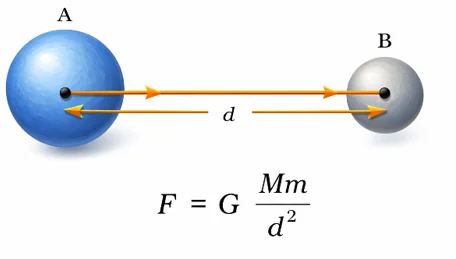
Imagine two objects A and B with masses M and m, separated by a distance d.
Let the gravitational force between them be F.
📌 1.
According to the universal law of gravitation, the force between two objects is directly proportional to the product of their masses. That is,
If either mass increases, the force increases.
📌 2.
the force between two objects is inversely proportional to the square of the distance between them, that is,
If distance doubles, the force becomes one-fourth.
📌 Combining both:
To convert this proportionality into an equation, we introduce a constant:
Here, G is the universal gravitational constant.
By multiplying crosswise
or
🧪 What Is “G”?
G stays the same everywhere in the universe. It does not change with location, planet or medium.
💡 SI Unit of G
By using the units of force (N), mass (kg), and distance (m), the SI unit becomes:
🔍 Value of G
This very small value explains why gravitational force between small everyday objects is extremely weak.
🧑🔬 Who measured G?
Henry Cavendish (1731–1810) measured the value of G using a very sensitive balance.
This experiment helped calculate Earth’s mass!
🤔 Did You Know?
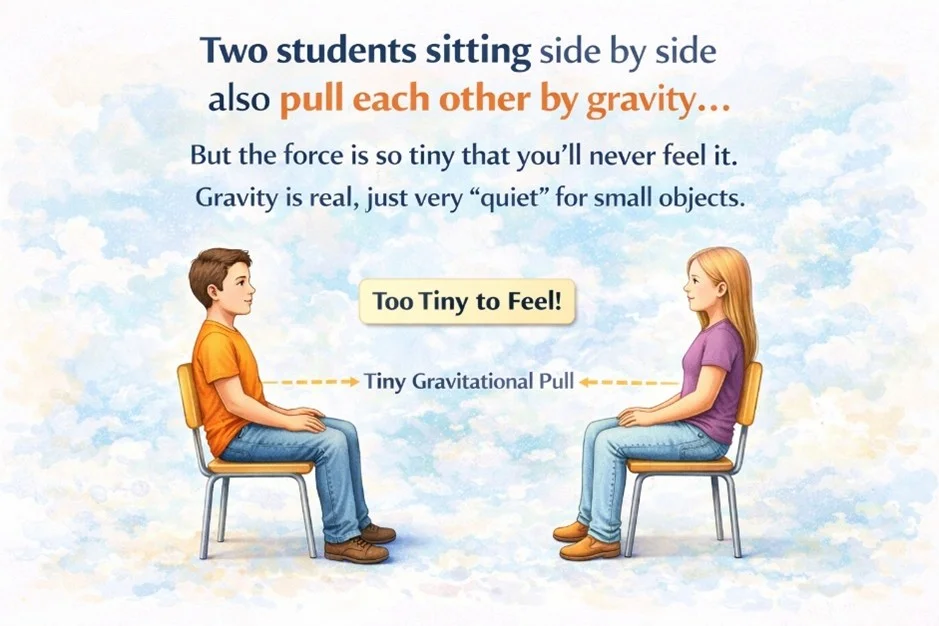
Two students sitting side by side also pull each other by gravity… but the force is so tiny that you’ll never feel it. Gravity is real, just very “quiet” for small objects.
🧠 Try This: Gravity Between You and a Friend
You and your friend sitting next to each other also attract each other due to gravity.
But you don’t feel this force because:
- • Your masses are small
- • Distance between you is not extremely small
- • Gravitational force becomes very tiny in such cases
That’s why only massive objects like Earth 🌍 or the Sun ☀️ create noticeable gravitational effects.
🌟 Example 9.1
The mass of the earth is 6x1024 kg and that of the moon is 7.4 × 10²² kg. If the distance between the earth and the moon is 3.84×10⁵ km, calculate the force exerted by the earth on the moon. (Take G = 6.7 × 10⁻¹¹ N m2 kg-2)
Answer: We are given:
🌍 Mass of Earth, M = 6 × 10²⁴ kg
🌙 Mass of Moon, m = 7.4 × 10²² kg
📏 Distance between Earth and Moon, d = 3.84 × 10⁵ km
Gravitational constant, G = 6.7 × 10⁻¹¹ N m² kg⁻²
🔁 Step 1: Convert distance to metres
1 km = 1000 m
d = 3.84 × 10⁵ km
d = 3.84 × 10⁵ × 1000 m
d = 3.84 × 10⁸ m
🧮 Step 2: Use the Universal Law of Gravitation
The formula is:
Substitute values:
✨ After solving:
✅ Final Answer
The gravitational force exerted by the Earth on the Moon is:
👉 2.02 × 10²⁰ newton (N)
This massive force keeps the Moon in its orbit around Earth.
🤔 Did You Know?
This force is so huge that it keeps the Moon in orbit, but the Moon doesn’t fall straight down because it is also moving forward continuously.
🤔Intext questions 🤔
❓ 1. State the universal law of gravitation.
✅ Answer:
🌌 The universal law of gravitation states that every object in the universe attracts every other object with a force.
📘 Explanation:
Now ,this pull or attracting force is:
👉 Directly proportional to the product of their masses
👉 Inversely proportional to the square of the distance between their centres
This force acts along the line joining their centres.
🤔 Did You Know?
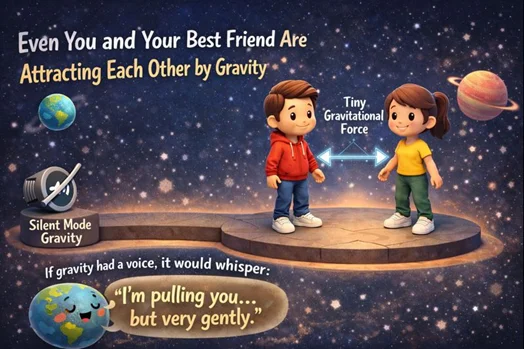
Even you and your best friend are attracting each other by gravity right now… but the force is so tiny that it’s basically “silent mode” gravity. If gravity had a voice, it would whisper: “I’m pulling you… but very gently.”
❓ 2. Write the formula to find the magnitude of the gravitational force between the earth and an object on the surface of the earth.
✅ Answer:
The gravitational force between Earth and an object is given by:
Where:
🌍 M = mass of Earth
📦 m = mass of the object
📏 R = radius of Earth
🔢 G = universal gravitational constant
This is also equal to:
(where g = 9.8 m/s²)
📘 Explanation
When an object of mass m is on Earth’s surface, Earth pulls it due to gravity.
In the universal gravitation formula:
🌍 M = mass of Earth
📦 m = mass of the object
📏 R = radius of Earth (distance from Earth’s center to the object on surface)
🔢 G = universal gravitational constant
Near Earth’s surface, the value GM/R^2 is the same for all objects and is called acceleration due to gravity g.
That’s why weight depends on mass: heavier mass ⇒ bigger force.
🤔 Did You Know?
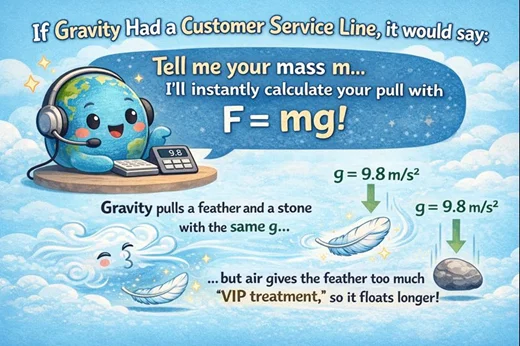
If gravity had a customer service line, it would say:
“Tell me your mass m… I’ll instantly calculate your pull with F = mg !” 😄
Also, the same gravity pulls a feather and a stone with the same g, but air gives the feather too much “VIP treatment,” so it floats longer! 🌬️🪶
🌟 9.1.2 Importance of the Universal Law of Gravitation
The universal law of gravitation helped explain many natural events that earlier seemed unrelated. Newton showed that one single force acts in all these situations.
✔️ (i) The force that binds us to the Earth.
Gravity keeps us firmly on the ground 🌍 and prevents us from floating away.
🤔 Did You Know?
Gravity is like Earth’s invisible glue: “No refund, no return… you belong here!” 😄🌍
✔️ (ii) Motion of the Moon around the Earth.
The moon stays in its orbit because Earth pulls it toward itself 🌙➡️🌏.
🤔 Did You Know?
The Moon is basically doing this forever: “I’m falling… but I keep missing Earth!” 😂🌙
✔️ (iii) Motion of planets around the Sun.
All planets revolve around the Sun due to the Sun’s strong gravitational pull ☀️🪐.
🤔 Did You Know?
The Sun is the “boss magnet” of the solar system: “Everyone… stay in line and keep circling!” 😄☀️🪐
✔️ (iv) Tides caused by the Moon and the Sun.
Tides in oceans rise and fall because the Moon and the Sun pull water on Earth 🌊🌕
🤔 Did You Know? (Funny style)
The Moon is like a giant ocean remote control: “Water… up! Water… down!” 🌕🌊😄
🌠 9.2 Free Fall
To understand free fall, try this small activity.
🎯 Activity 9.2
- ✔️ Take a stone.
- ✔️ Throw it upward.
- ✔️ It rises to a certain height and then begins to fall back down.
We know the Earth pulls objects toward itself because of gravitational force.
Whenever an object falls only under the influence of gravity, we say it is in free fall.
⬇️ Does the velocity change during free fall?
While falling, the object’s direction does not change, but its speed increases because Earth pulls it downward.
A change in velocity means acceleration.
👉 Acceleration due to gravity (g)
This acceleration is caused by Earth’s gravity, so it is called acceleration due to gravity (g).
Its unit is m s⁻².
⚡ Relationship between Force and Acceleration
From the second law of motion:
For free fall, acceleration = g
We also know from universal gravitation:
Equating both forces:
Cancel m from both sides:
✅ Key Result
This formula gives the value of gravitational acceleration at any distance d from Earth.
🌍 On or Near the Earth’s Surface
If an object is on or near Earth’s surface:
d = R (radius of Earth)
So the formula becomes:
This explains why g is slightly greater at the poles (smaller radius) and slightly lower at the equator (larger radius).
For most calculations on Earth, we take g = 9.8 m s⁻².
🧮 9.2.1 Calculating the Value of g
Use the formula:
Substitute values:
Universal gravitational constant , G = 6.7 × 10⁻¹¹ N m² kg⁻²
Mass of the earth , M = 6 × 10²⁴ kg
Radius of the earth , R = 6.4 × 10⁶ m
Putting values:
After calculation:
👉 Thus, acceleration due to gravity = 9.8 m s⁻².
🌍 9.2.2 Motion of Objects Under the influence of Gravitational force of Earth
🧪 1. Do all objects fall at the same rate?
- • When objects fall freely, they experience an acceleration called g.
- • From the formula of g, this acceleration does not depend on mass.
- • So big or small, hollow or solid — all objects fall at the same rate (if air resistance is ignored).
- • Galileo showed this by dropping different objects from the Leaning Tower of Pisa 🏛️.
🤔 Did You Know?
A feather and a stone would fall together… but air is like that one friend who keeps interrupting the race! 😄🪶🪨
⚡ 2. Why do all objects fall equally?
- • Near Earth, g is constant (about 9.8 m/s²).
- • Since all objects get the same g, they all speed up at the same rate during free fall.
🤔 Did You Know?
Gravity doesn’t check your size, brand, or weight. It’s like: “Everyone gets the same speed boost!” 😂⬇️
📘 3. Using the Equations of Motion with g
In free fall, we replace the usual acceleration a with g.
1️⃣ v = u + gt
2️⃣ s = ut + ½ gt²
3️⃣ v² = u² + 2gs
Where:
- u = initial velocity
- v = final velocity
- s = distance
- t = time
- g = 9.8 m/s²
🤔 Did You Know?
These three equations are like the “free fall toolkit.” Just pick the one that matches your question and you’re done! 😄🧰
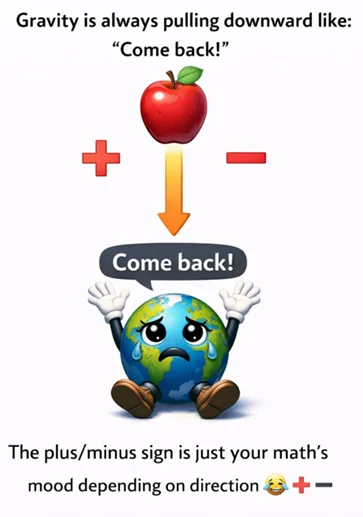
4. Choosing Positive (➕) or Negative (➖) g.
✔️ Take g as positive when the object moves downward (same direction as gravity). ⬇️
✔️Take g as negative when the object moves upward (opposite to gravity). ⬆️
🤔 Did You Know?
Gravity is always pulling downward like: “Come back!” 😄
The plus/minus sign is just your math’s mood depending on direction 😂➕➖
🌟 Example 9.2
A car falls off a ledge and drops to the ground in 0.5 s. Let g = 10 m s–2 (for simplifying the calculations).
(i) What is its speed on striking the ground?
(ii) What is its average speed during the 0.5 s?
(iii) How high is the ledge from the ground?
✅ Given:
👉 Time, t = 0.5 s
👉 Acceleration due to gravity, g = 10 m/s²
👉Initial velocity, u = 0 (car just falls, not thrown)
Time, t = ½ or 0.5 second
Initial velocity, u = 0 m s–1
Acceleration due to gravity, g = 10 m s–2
Acceleration of the car, a = + 10 m s–2 (downward)
🌟 (i) Speed on striking the ground
Use the formula: v = u + at
v = 0 + (10 × 0.5)
v = 5 m/s
👉 Speed = 5 m/s on hitting the ground.
🌟 (ii) Average speed during 0.5 s
Average speed during uniformly accelerated motion is:
Average speed = (u + v) / 2
= (0 + 5) / 2
= 2.5 m/s
👉 Average speed = 2.5 m/s
🌟 (iii) Height of the ledge
Use:
= ½ × 10 m s–2 × (0.5 s)2
= ½ × 10 m s–2 × 0.25 s2
= 1.25 m
👉 Height of the ledge = 1.25 m
🎉 Final Answers
- Speed on striking ground: 5 m/s
- Average speed: 2.5 m/s
- Height of ledge: 1.25 m
🎯 Example 9.3
An object is thrown vertically upwards and rises to a height of 10 m. Calculate
(i) the velocity with which the object was thrown upwards and
(ii) the time taken by the object to reach the highest point.
✅ Given:
• Height reached, s = 10 m
• Final velocity at top, v = 0 m/s (object momentarily stops)
• Acceleration due to gravity, g = 9.8 m/s²
• Since the object is going up, gravity acts down, so:
👉 a = –9.8 m/s²
🌟 (i) Finding the initial velocity (u)
Use the formula:
v2=u2+2as
Substitute values:
0 = u² + 2 × (–9.8) × 10
0 = u² – 196
u² = 196
u = √196
u = 14 m/s
👉 Initial velocity = 14 m/s
(The negative sign is ignored because velocity is upward.)
🌟 (ii) Time to reach the highest point
Use:
v=u+at
0 = 14 + (–9.8)t
9.8t = 14
t = 14 / 9.8
t = 1.43 s
👉 Time taken = 1.43 s
🎉 Final Answers
- Initial velocity = 14 m/s ⬆️
- Time to reach highest point = 1.43 s ⏱️
🤔 Intext Questions🤔
❓ 1. What do you mean by free fall?
✅ Answer:
🌟 Free fall is the motion of an object when it falls only under the influence of Earth's gravitational force, with no other forces acting on it.
In free fall, air resistance is ignored and the object accelerates downward due to gravity.
🤔 Did You Know? (Funny style)
If air resistance didn’t exist, a feather and a stone would land together.
Air is basically the “spoiler” that makes the feather look slow! 😄🪶🪨
❓ 2. What do you mean by acceleration due to gravity?
✅ Answer:
⬇️ Acceleration due to gravity (g) is the acceleration produced in a freely falling object by Earth’s gravitational pull.
It has a value of 9.8 m/s² near the Earth’s surface and acts downward.
🤔 Did You Know?
Gravity gives every falling object the same message:
“Speed up by 9.8 m/s every second… no excuses!” 😂⬇️
⚖️ 9.3 Mass
🌟 What is Mass?
- • Mass is a measure of inertia — how difficult it is to change the state of motion of an object.
- • Greater mass → greater inertia.
🌍 Does mass change from place to place?
- • No. Mass remains the same on Earth, on the Moon, and even in outer space.
- • Mass is a constant for an object and does not depend on location.
🤔 Did You Know?
Your mass is like your “permanent ID” 😄
Even if you go to the Moon, your mass will be the same…
Only your weight will take a vacation and become lighter! 🌙🏖️
🏋️ 9.4 Weight
🌟 What is Weight?
- • Weight is the force with which Earth pulls an object towards itself.
- • It depends on two things:
- 🤔 Mass of the object (m)
- 🤔 Acceleration due to gravity (g)
🔢 Formula for Weight
We know:
F = m × a
For falling objects,
F = m × g
So weight (W) is:
👉 W = m × g
🧭 SI Unit of Weight:
- • Weight is a force, so its SI unit is newton (N).
- • Weight acts vertically downward.
- • It has magnitude and direction, so it is a vector quantity.
🤔 Did You Know?
Your mass stays loyal like a best friend 😄
But your weight is moody like:
“Earth pe heavy… Moon pe light!” 🌍➡️🌙😂
📌 Mass vs Weight
✔️ Mass
- • Constant everywhere
- • Does not depend on location
✔️ Weight
- • Depends on g
- • Changes from place to place (Earth, Moon, planets)
- • At a fixed place, W is directly proportional to m (W ∝ m)
👉 That’s why at a single location, you can use weight to measure mass.
🤔 Did You Know?
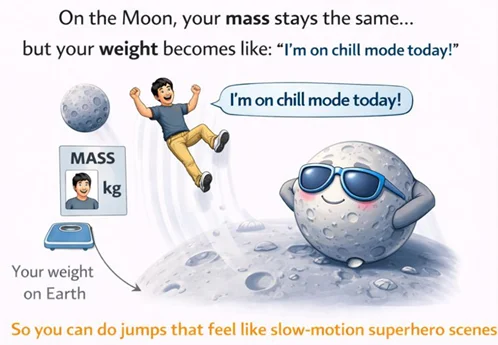
On the Moon, your mass stays the same…
but your weight becomes like: “I’m on chill mode today!” 😄🌙
So you can do jumps that feel like slow-motion superhero scenes 🦸♂️✨
| Feature | Mass ⚖️ | Weight 🏋️ |
|---|---|---|
| Meaning | Amount of matter in an object | Force with which Earth pulls the object |
| Symbol | m | W |
| Formula | – | W = m × g |
| Unit | kilogram (kg) | newton (N) |
| Nature | Scalar quantity (only magnitude) | Vector quantity (magnitude + direction) |
| Direction | No direction | Acts vertically downward |
| Depends on | Only amount of matter | Mass (m) and gravity (g) |
| Changes with location? | ❌ No | ✔️ Yes (because g changes) |
| Same on Earth & Moon? | ✔️ Yes | ❌ No |
🧮 Numerical Questions (with answers)
Here are simple, exam-oriented numerical questions.
1️⃣ A boy has a mass of 40 kg. What is his weight on Earth? (g = 9.8 m/s²)
Solution: W = m × g = 40 × 9.8 = 392 N
2️⃣ Find the weight of a 12 kg object on the Moon. (g on Moon = 1.6 m/s²)
W = m × g = 12 × 1.6 = 19.2 N
3️⃣ A stone weighs 98 N on Earth. What is its mass? (g = 9.8 m/s²)
W = m × g
98 = m × 9.8
m = 98 ÷ 9.8
m = 10 kg
4️⃣ An object has a mass of 5 kg. What is its weight at a place where g = 10 m/s²?
W = m × g = 5 × 10 = 50 N
5️⃣ If the weight of an astronaut on Earth is 600 N, what will be his weight on the Moon? (g on Moon = 1/6 of Earth)
W on Moon = 600 × 1/6 = 100 N
6️⃣ An object weighs 20 N on the Moon. What is its weight on Earth? (g on Moon = 1.6 m/s², g on Earth = 9.8 m/s²)
First, find mass:
m = W / g(moon)
m = 20 ÷ 1.6
m = 12.5 kg
Now, weight on Earth:
W = m × g
W = 12.5 × 9.8
W = 122.5 N
🌙 9.4.1 Weight of an Object on the Moon
⭐ Why is weight on the Moon different?
- • Weight is the force with which a body is attracted by a planet or moon.
- • The Moon has much less mass than the Earth.
- • So the Moon’s gravitational pull is weaker → objects weigh less on the Moon.
⚖️ Weight of an Object on the Moon
Let:
• Mass of object = m
• Weight on Moon = Wₘ
• Mass of Moon = Mₘ
• Radius of Moon = Rₘ
Using the universal law of gravitation:
🌍 Weight of the Same Object on Earth
Let:
• Weight on Earth = Wₑ
• Mass of Earth = M
• Radius of Earth = R
🔢 Substituting values (from Table 10.1)
Moon values
Mass of Moon = 7.36×10²² kg
Radius of Moon = 1.74×10⁶ m
Earth values
Mass of Earth = 6×10²⁴ kg
Radius of Earth = 6.4×10⁶ m
👉 (6.4×10⁶ m)² = 40.96 × 10¹² m²
📉 Finding the Ratio
🎉 Final Result
🌙 Weight of an object on the Moon = 1/6 × Weight on Earth
✔️ Important Point
- • Mass stays same everywhere.
- • Weight becomes one-sixth on the Moon because the Moon’s gravity is much weaker.
🤔 Did You Know?
Your mass is like your permanent “identity” 😄
But your weight is like your mood:
On Earth: “Heavy!” 🌍
On Moon: “Light and happy!” 🌙😂
🌟 Example 9.4
Mass of an object is 10 kg. What is its weight on the earth?
Solution:
Mass, m = 10 kg
Acceleration due to gravity, g = 9.8 m s–2
W = m × g
W = 10 kg × 9.8 m s-2
= 98 N
Thus, the weight of the object is 98 N.
🌟 Example 9.5
An object weighs 10 N when measured on the surface of the earth. What would be its weight when measured on the surface of the moon?
Solution:
We know,
Weight of object on the moon = (1/6) × its weight on the earth.
Wmoon = (1/6) × 10 N = 1.67 N
Thus, the weight of object on the surface of the moon would be 1.67 N.
📌 Intext questions📌
❓ 1. What are the differences between the mass of an object and its weight?
✅ Answer:
⚖️ Mass
- • Mass is the amount of matter in an object.
- • It is constant everywhere (Earth, Moon, space).
- • It is measured in kilograms (kg).
- • It is a scalar quantity (no direction).
- • It is measured using a beam balance.
🏋️ Weight
- • Weight is the force with which Earth attracts an object.
- • Weight changes from place to place because gravity changes.
- • It is measured in newtons (N).
- • It is a vector quantity (acts downward).
- • It is measured using a spring balance.
❓ 2. Why is the weight of an object on the Moon 1/6of its weight on the Earth?
✅ Answer:
🌙 The weight of an object on the Moon is 1/6of its weight on Earth because:
- The Moon has much smaller mass than the Earth.
- The Moon also has a smaller radius.
- Due to these two reasons, the Moon’s gravitational pull is weaker.
Since weight = m × g, the weight becomes:
👉 So objects weigh six times lighter on the Moon.
🌟 9.5 Thrust and Pressure
Have you ever wondered:
- 🐪 Why a camel can walk easily on desert sand?
- 🚛 Why trucks and buses have wider tyres?
- 🛠️ Why cutting tools (like knives) have sharp edges?
- 🚜 Why an army tank can move without sinking?
To understand these, we need two concepts:
🔵 1. What is Thrust?
Thrust is the force acting perpendicular (at 90°) to a surface.
Examples:
📌 Situation 1: Pressing a drawing pin
- • You press the head of the pin with your thumb.
- • The force you apply acts perpendicular to the board.
- • This force is thrust.
📌 Situation 2: Standing vs lying on loose sand
- • When you stand, your weight acts on a small area (your feet).
- • When you lie down, the same weight spreads over a larger area (your whole body).
- • The force (your weight) is the same → thrust is the same.
- • But the effect is different because areas are different.
🔵 2. Why is the effect different?
The effect of thrust depends on the area over which it acts.
- • Small area → large effect (you sink deeper in sand while standing)
- • Larger area → smaller effect (you don’t sink while lying down)
🔵 3. What is Pressure?
👉 Pressure tells us how much force acts on one unit area.
If the same thrust acts on:
- • small area ⇒ high pressure
- • large area ⇒ low pressure
🔵 4. SI Unit of Pressure
Thrust = Force = Newton (N)
Area = m²
So:
To honour scientist Blaise Pascal, the SI unit of pressure is named:
👉 Pascal (Pa)
🌟 Why are these ideas useful?
- • Camels don’t sink in sand because their feet spread weight over a large area → less pressure 🐪
- • Tanks move on tracks to spread weight → low pressure
- • Wide tyres reduce pressure, preventing vehicles from sinking in soft ground 🚚
- • Sharp tools have tiny edges → high pressure → easy cutting 🔪
🤔 Did You Know?
A knife is basically saying: “Give me a super tiny edge and I’ll cut like a superhero!” 😄🔪🦸♂️
🌟 Example 9.6
A block of wood is kept on a tabletop. The mass of wooden block is 5 kg and its dimensions are 40 cm × 20 cm × 10 cm. Find the pressure exerted by the wooden block on the table top if it is made to lie on the table top with its sides of dimensions
(a) 20 cm × 10 cm and
(b) 40 cm × 20 cm.
⭐ Given:
- • Mass of wooden block = 5 kg
- • Dimensions = 40 cm × 20 cm × 10 cm
- • g = 9.8 m/s²
The block exerts a thrust (its weight) on the table surface.
⚡ Step 1: Calculate Thrust (Weight)
So, the block pushes the table with 49 N of force.
🟦 Case 1: Block lying on the 20 cm × 10 cm side
👉 Find area
Convert to m²:
👉 Pressure
✅ Pressure on small face = 2450 N/m²
🟩 Case 2: Block lying on the 40 cm × 20 cm side
👉 Find area
Convert to m²:
👉 Pressure
✅ Pressure on large face = 612.5 N/m²
🎉 Conclusion
- • Smaller area → larger pressure
- • Larger area → smaller pressure
| Side (cm) | Area (m²) | Pressure (N/m²) |
|---|---|---|
| 20 × 10 | 0.02 | 2450 |
| 40 × 20 | 0.08 | 612.5 |
👉 The small face exerts 4 times more pressure than the large face.
🌊 9.5.1 Pressure in Fluids
⭐ Key Points
- • Liquids and gases are called fluids.
- • Just like solids exert pressure due to weight, fluids also exert pressure.
- • Fluids exert pressure on:
- 👉 the base of the container
- 👉 the walls of the container
📌 Pascal’s Observation
Pressure applied to a confined fluid is transmitted equally in all directions.
This is why hydraulic brakes, syringes and hydraulic lifts work.
🟦 9.5.2 Buoyancy
⭐ Why do we feel lighter in water?
When you swim or lift a bucket out of water:
- • Water pushes upwards on the object.
- • This upward force is called buoyant force or upthrust.
⭐ Activity explanation (bottle in water)
- • Earth’s gravity pulls the bottle downwards.
- • Water pushes the bottle upwards.
- • If the upward force > weight → bottle moves up.
- • To keep the bottle fully inside water, you must apply extra downward force.
⭐ Important Definition
Buoyant force / Upthrust
→ Upward force exerted by a fluid on an object immersed in it.
⭐ What affects buoyant force?
- • It depends on the density of the fluid.
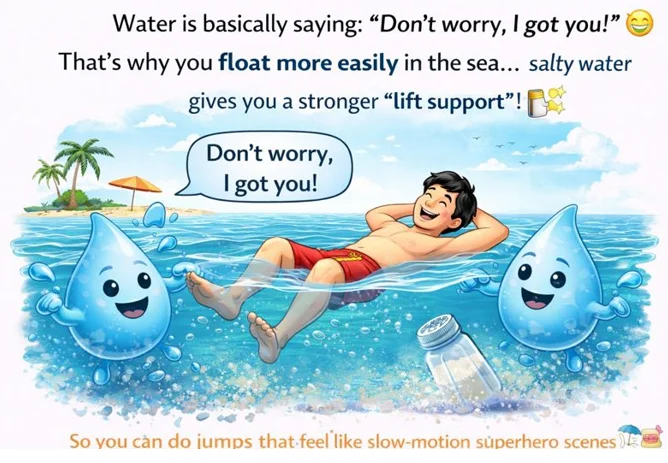
- • Denser fluids (like salty water) give more buoyant force.
🤔 Did You Know?
Water is basically saying: “Don’t worry, I got you !” 😄🌊
That’s why you float more easily in the sea… salty water gives you a stronger “lift support”! 🧂🏖️
🟩 9.5.3 Why Objects Float or Sink?
🧪 Observation
👉 A nail sinks.
👉 A cork floats.
⭐ Explanation
Two forces act on an object placed in water:
- Weight (downwards) → pulls object down
- Upthrust (upwards) → pushes object up
The float or sink condition depends on which force is greater.
📘 Floating Condition
An object floats when: Upthrust > Weight
This happens when the density of the object is less than the density of water.
Example:
📌 Cork → low density → floats easily 🟫⬆️
📕 Sinking Condition
An object sinks when: Weight > Upthrust
This happens when the density of the object is greater than the density of water.
Example:
• Iron nail → high density → sinks instantly ⚫⬇️
🎉 Final Rules
- ✔️ If density of object < density of liquid → Floats
- ✔️ If density of object > density of liquid → Sinks
🤔 Did You Know?
A nail sinks because it’s like: “I’m too heavy, bye!” 😂⬇️
Cork floats because it’s like: “Water is my comfy sofa!” 😄⬆️🌊
📌 Intex questions📌
❓ 1. Why is it difficult to hold a school bag having a strap made of a thin and strong string?
✅ Answer:
🎒 It is difficult because a thin strap has very small area.
- • Your bag’s weight (thrust) acts on this small area.
- • Smaller area → greater pressure on your shoulder.
- • This high pressure causes pain, making it hard to carry.
👉 A wider strap spreads the force over a larger area → less pressure → more comfortable.
❓ 2. What do you mean by buoyancy?
✅ Answer:
🌊 Buoyancy (or upthrust) is the upward force exerted by a fluid (like water or air) on an object placed in it.
This force makes objects feel lighter when they are immersed in water.
❓ 3. Why does an object float or sink when placed on the surface of water?
✅ Answer:
An object floats or sinks depending on its density compared to water.
🟦 Floating: If density of object < density of water
→ Upthrust > Weight
→ Object floats.
🟥 Sinking: If density of object > density of water
→ Upthrust < Weight
→ Object sinks.
👉 Example:
• Cork floats because it is less dense.
• Iron nail sinks because it is more dense.
🌊 9.6 Archimedes’ Principle
⭐ What happens when a stone is lowered into water?
When a stone hanging from a spring balance is slowly dipped into water:
- • The reading of the spring balance decreases.
- • This means the string feels less weight than before.
- • Why? Because water pushes the stone upwards.
- • This upward force is called buoyant force or upthrust.
Once the stone is fully immersed, the reading stops changing.
→ The upward force has reached its full value.
🟦 Why does the reading decrease?
- • The stone has weight acting downwards.
- • Water exerts an upward buoyant force on the stone.
- • Because of this upward force, the net downward force becomes smaller.
- • So the spring balance shows a smaller reading.
🟩 Archimedes’ Principle (Important Definition)
📌 Archimedes’ Principle states:
👉 When a body is fully or partially immersed in a fluid, it experiences an upward force (buoyant force) equal to the weight of the fluid displaced by it.
This is one of the most important principles in physics.
🧠 Understanding the Activity
Why does the reading stop changing after full immersion?
- • When the stone is fully inside the water, it displaces a fixed amount of water.
- • The buoyant force becomes constant.
- • So the reading on the spring balance becomes steady.
🚢 Applications of Archimedes’ Principle
Archimedes’ principle is used in:
- 🛳️ 1. Designing ships and submarines
- Ships float because the water they displace creates enough buoyant force.
- 🥛 2. Lactometers
- Used to check the purity of milk.
- 💧 3. Hydrometers
- Used to measure the density of liquids.
🤔 Did You Know?
Archimedes discovered this in a bath and basically shouted “Eureka!” 😄🛁
So yes… one of the biggest physics discoveries happened during a shower-thought moment! 🚿✨
📌 Intex questions📌
❓ 1. You find your mass to be 42 kg on a weighing machine. Is your mass more or less than 42 kg?
✅ Answer:
⚖️ Your actual mass is slightly more than 42 kg.
A weighing machine measures your apparent weight, not exact mass.
- • When you stand on it, the machine also feels a small upward buoyant force from the air.
- • This reduces the reading very slightly.
👉 So, your true mass is a little greater than 42 kg, but the difference is very small.
🤔 Did You Know?
Air also “lifts” you a tiny bit…
So technically your weighing machine is being a little polite:
“Don’t worry, I’ll show you a slightly smaller number!” 😄🌬️⚖️
❓ 2. You have a bag of cotton and an iron bar, each indicating a mass of 100 kg on a weighing machine. In reality, one is heavier than the other. Can you say which one is heavier and why?
✅ Answer:
🧺 The cotton bag is actually heavier than the iron bar.
✔️ Why?
- • Cotton has much larger volume than iron for the same mass.
- • Because cotton occupies more space, it displaces more air.
- • Greater air displacement → greater buoyant force from air.
- • Buoyant force reduces the reading on the weighing machine.
So:
👉 The cotton appears to weigh less than its real weight.
👉 The iron bar shows a reading closer to its true value.
Therefore, with the same machine reading of 100 kg, the cotton bag is actually heavier.
🤔 Did You Know?
Cotton is like: “I’m big, so air will help me look lighter!” 😄🌬️🧺
Iron is like: “No air tricks for me… I’m dense and honest!” 😂⚫