
📘 NCERT Intext Questions — A Journey through States of Water (Class 6)
💧 Q.1. Reflect on what you did really well in this activity.
(Page No. 101)
Show Answer
💧 Q.1. Reflect on what you did really well in this activity.
(Page No. 101)
Answer: I spread some water on a plate and also kept a little water in a bottle cap.
I observed that water on the plate evaporated faster because a larger surface area was exposed to air.
In the bottle cap, the water evaporated slowly since less surface was open to air. I compared both carefully and recorded my observations neatly. 🌞💨
💡 Did You Know?
The larger the exposed surface area, the faster evaporation takes place — that’s why puddles dry quicker than water in a cup! 💧
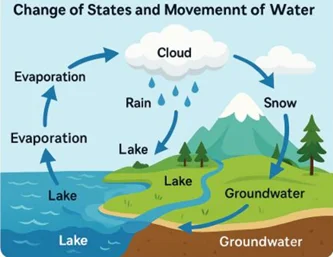
🌧️ Q.2. What did I do well? Was I able to label all the parts of the water cycle? Which parts of the water cycle were unclear to me?
(Page No. 102)
Show Answer
🌧️ Q.2. What did I do well? Was I able to label all the parts of the water cycle? Which parts of the water cycle were unclear to me?
(Page No. 102)
Answer: I did well in understanding and labelling most parts of the water cycle.
I was able to correctly label Evaporation, Condensation, Rain, Cloud, River, Lake, and Ocean. 🌊☁️🌧️
These helped me understand how water changes its state and moves in nature.
However, I found it a bit unclear to show Groundwater and how snow forms on mountains during condensation. I’ll revise this part again for better understanding. ❄️💧
(Label the given parts of the Water Cycle diagram.)
📘 Diagram Labelling – The Water Cycle
Use the given words to label the diagram correctly:
➡️ Cloud
➡️ Evaporation (from Ocean, Lake, and River)
➡️ Condensation (formation of clouds)
➡️ Rain / Snow (precipitation)
➡️ River → Lake → Ocean (collection of water)
➡️ Groundwater (water stored under the Earth’s surface)
Use the given words to label the diagram correctly:
➡️ Cloud
➡️ Evaporation (from Ocean, Lake, and River)
➡️ Condensation (formation of clouds)
➡️ Rain / Snow (precipitation)
➡️ River → Lake → Ocean (collection of water)
➡️ Groundwater (water stored under the Earth’s surface)
🌀 Process Summary:
The water from oceans, lakes, and rivers evaporates into the air as vapour. It condenses to form clouds and then returns as rain or snow. This water flows back into rivers and oceans, completing the water cycle. 🌧️🌊
💡 Did You Know?
Only about 1% of all water on Earth is freshwater that humans and animals can use — the rest is salt water or frozen! ❄️💦
Let us enhance our learning
☁️ Q.1. Which of the following best describes condensation?
Show Answer
☁️ Q.1. Which of the following best describes condensation?
(i) The conversion of water into its vapour state.
(ii) The process of water changing from a liquid into a gaseous state.
(iii) The formation of clouds from tiny water droplets.
(iv) The conversion of water vapour into its liquid state.
Answer: (iv) The conversion of water vapour into its liquid state.
💡 Explanation:
When water vapour cools down, it becomes liquid water again. This process is called condensation — it forms dew, fog, and clouds in nature. 🌫️☁️
🌞 Q.2. Identify in which of the given processes, evaporation is very important —
Show Answer
🌞 Q.2. Identify in which of the given processes, evaporation is very important —
(i) Colouring with:
(a) crayons (b) water colours (c) acrylic colours (d) pencil colours
Answer: (b) Water colours 🎨
💡 Explanation:
When we paint using water colours, the water evaporates, leaving behind the colour on paper.
(ii) Writing on paper with:
(a) pencil (b) ink pen (c) ball point pen
Answer: (b) Ink pen ✍️
💡 Explanation:
In ink pens, the liquid ink dries up due to evaporation, making the writing permanent.
🌿 Q.3. We see green plastic grass at many places these days. Space around natural grass feels cooler than space around plastic grass. Can you find out why?
Show Answer
🌿 Q.3. We see green plastic grass at many places these days. Space around natural grass feels cooler than space around plastic grass. Can you find out why?
Answer: Natural grass contains water that evaporates slowly, using heat from the surroundings. This reduces the air temperature and makes the area feel cooler. 🌬️💧
Plastic grass does not contain water, so no evaporation happens — the area stays hotter.
💡 Did You Know? Evaporation is a natural cooling process — that’s why we sweat when it’s hot! 😅
🧴 Q.4. Give examples of liquids other than water that evaporate.
Show Answer
🧴 Q.4. Give examples of liquids other than water that evaporate.
Answer: Some liquids that evaporate easily are —
1️⃣ Alcohol (used in sanitizers) 🧼
2️⃣ Perfume or deodorant 💨
3️⃣ Petrol or kerosene ⛽
💡 Explanation: These liquids are volatile, meaning they evaporate quickly even at room temperature.
💨 Q.5. Fans move air around, creating a cooling sensation. It might seem strange to use a fan to dry wet clothes since fans usually make things cooler, not warmer. Normally, when water evaporates, it requires heat, not cold air. What do you think about this?
Show Answer
💨 Q.5. Fans move air around, creating a cooling sensation. It might seem strange to use a fan to dry wet clothes since fans usually make things cooler, not warmer. Normally, when water evaporates, it requires heat, not cold air. What do you think about this?
Answer: The fan helps by moving air and carrying away the moist air from the clothes. This allows dry air to come in contact with the wet surface again, speeding up evaporation — even though the air itself is cool. 🌬️👕
💡 Tip: Evaporation depends more on air movement and exposed area than just heat.
🏞️ Q.6. Usually, when sludge is removed from drains, it is left in heaps next to the drain for 3–4 days. Afterward, it is transported to a garden or a field where it can be used as manure. This approach reduces the transportation cost of the sludge and enhances the safety of individuals handling it. Reflect upon it and explain how.
Show Answer
🏞️ Q.6. Usually, when sludge is removed from drains, it is left in heaps next to the drain for 3–4 days. Afterward, it is transported to a garden or a field where it can be used as manure. This approach reduces the transportation cost of the sludge and enhances the safety of individuals handling it. Reflect upon it and explain how.
Answer: The sludge contains a lot of water. When left in heaps, sunlight and wind cause the water to evaporate, making it dry and lighter. ☀️💨 This makes it easier and cheaper to transport.
💡 Did You Know? This method uses natural evaporation — an eco-friendly way to dry and reuse waste without machines or extra fuel. 🌍♻️
💨 Q.7. Observe the activities in your house for a day. Identify the activities that involve evaporation. How does understanding the process of evaporation help us in our daily activities?
Show Answer
💨 Q.7. Observe the activities in your house for a day. Identify the activities that involve evaporation. How does understanding the process of evaporation help us in our daily activities?
Answer: Some activities at home where evaporation takes place are —
1️⃣ Drying wet clothes under the fan or sun 👕
2️⃣ Cooling hot tea or milk when left open ☕
3️⃣ Drying mopped floors after cleaning 🧹
4️⃣ Sweating — our body cools down when sweat evaporates 🌞
Understanding evaporation helps us:
• Dry clothes faster by spreading them out or using fans,
• Store perfumes, fuels, and liquids carefully to avoid quick loss,
• Use evaporation for cooling, like in earthen pots (matkas).
• Dry clothes faster by spreading them out or using fans,
• Store perfumes, fuels, and liquids carefully to avoid quick loss,
• Use evaporation for cooling, like in earthen pots (matkas).
💡 Did You Know? Evaporation is a natural cooling process, that’s why sweat helps our body stay cool on hot days! 😅
🧊 Q.8. How is water present in the solid state in nature?
Show Answer
🧊 Q.8. How is water present in the solid state in nature?
Answer: In nature, water in its solid state is found as:
• Ice on mountains and glaciers 🏔️
• Snow in cold regions ❄️
• Hailstones during storms 🌨️
• Icebergs floating in polar seas 🧊
💡 Tip: When the temperature falls below 0°C, water freezes and turns into solid ice.
🌍 Q.9. Reflect on the statement — “Water is our responsibility before it is our right.” Share your thoughts.
Show Answer
🌍 Q.9. Reflect on the statement — “Water is our responsibility before it is our right.” Share your thoughts.
Answer: This statement means that we should take care of water before we claim the right to use it. Water is essential for life, and wasting or polluting it harms everyone.
We can be responsible by:
💧 Turning off taps properly,
🌿 Using only the water we need,
🚯 Keeping water bodies clean,
🌦️ Storing rainwater (rainwater harvesting).
💧 Turning off taps properly,
🌿 Using only the water we need,
🚯 Keeping water bodies clean,
🌦️ Storing rainwater (rainwater harvesting).
💡 Conclusion: Every drop of water is precious. Saving water is not just a choice — it’s our duty! 💙
☀️ Q.10. The seat of a two-wheeler parked on a sunny day has become very hot. How can you cool it down?
Show Answer
☀️ Q.10. The seat of a two-wheeler parked on a sunny day has become very hot. How can you cool it down?
Answer: To cool down the hot seat:
1️⃣ Sprinkle or pour a little water on it. 💧
2️⃣ Wait for a few minutes — as the water evaporates, it absorbs heat from the seat.
3️⃣ The seat becomes cooler and comfortable to sit on. 🛵
💡 Did You Know? Evaporation always causes cooling because it uses up heat energy from the surrounding surface. 🌡️⬇️
📚 Explore More Class 6 Chapters (Questions and Answers)
🌍Chapter 1 – The Wonderful World of Science
🦁Chapter 2 – Diversity in the Living World
🥗Chapter 3 – Mindful Eating
🧲Chapter 4 – Exploring Magnets
📏Chapter 5 – Measurement of Length & Motion
🧱Chapter 6 – Materials Around Us
🌡️Chapter 7 – Temperature & Measurement
💧Chapter 8 – States of Water
⚗️Chapter 9 – Methods of Separation
🐾Chapter 10 – Living Creatures
🌿Chapter 11 – Nature's Treasures
🚀Chapter 12 – Beyond Earth
